

Chapter 10 Mensuration (Concepts)
Welcome to Chapter 10: Mensuration! This chapter focuses on measurement, specifically for flat shapes (plane figures). We will explore two critical properties: Perimeter, the length of the boundary around a shape, and Area, the amount of space a shape covers. These concepts are fundamental in design, construction, and everyday life.
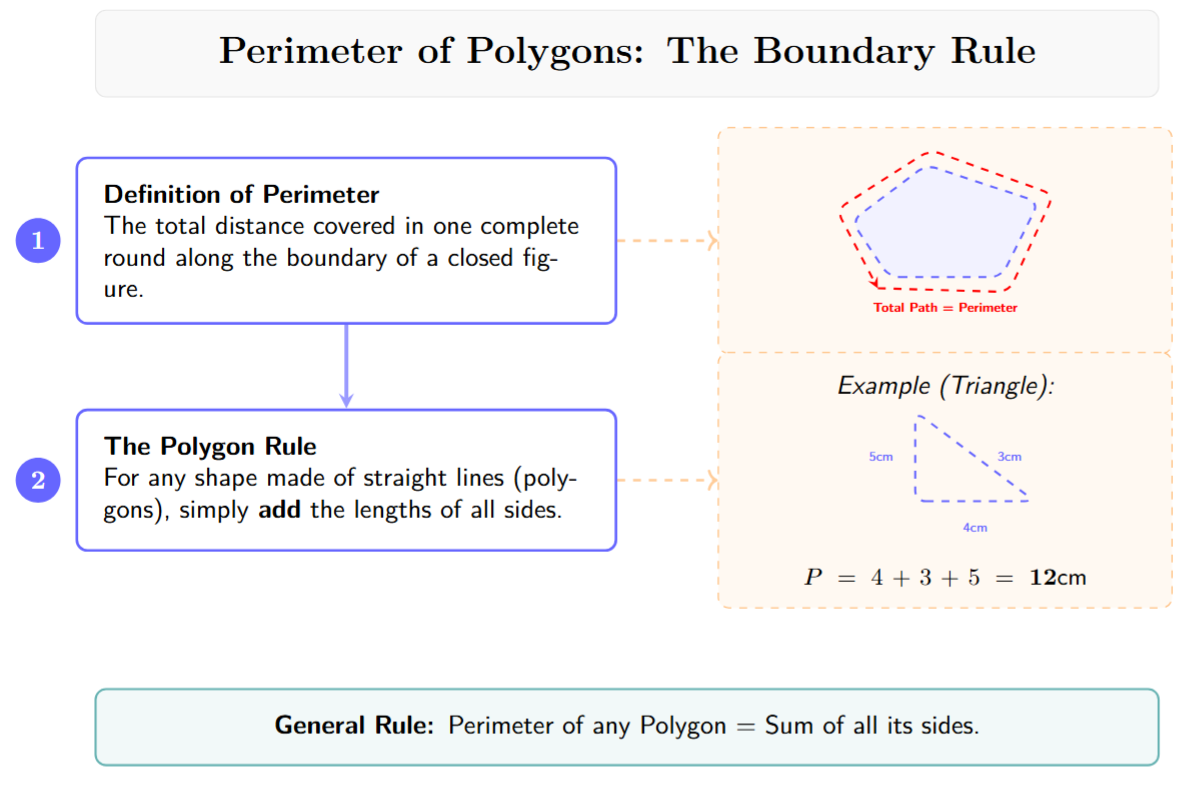
Perimeter is the total distance around a closed figure's boundary. For polygons, it's found by adding all side lengths. For example, a triangle with sides 3, 4, and 5 cm has a perimeter of $3+4+5=12$ cm. Shortcuts exist for regular polygons:
- Perimeter of an Equilateral Triangle = $3 \times (\text{side})$
- Perimeter of a Square = $4 \times (\text{side})$
Area represents the surface region enclosed within a boundary. It quantifies how much space a shape occupies and is measured in square units (e.g., $cm^2$, $m^2$). While counting squares can illustrate area, we'll use precise formulas for common shapes:
- Area of a Rectangle = Length $\times$ Breadth ($A = l \times b$)
- Area of a Square = Side $\times$ Side ($A = s \times s = s^2$)
This chapter uses visualizations, flowcharts, mind maps, and practical examples. These resources, meticulously prepared by learningspot.co, will make understanding and calculating perimeter and area both straightforward and practical.
| Content On This Page | ||
|---|---|---|
| Perimeter of Plane Figures | Area of Plane Figures | |
Perimeter of Plane Figures
Mensuration is a vital branch of mathematics that focuses on measuring geometric figures. It allows us to quantify properties like length, area, and volume. In this section, we will start by exploring the concept of the perimeter of plane figures. A plane figure is a two-dimensional shape that lies completely on a flat surface (a plane), such as a square, rectangle, triangle, or circle. A closed plane figure is one that has no open ends, its boundary forms a complete loop.
What is Perimeter?
The Perimeter of a closed plane figure is defined as the total length of its boundary. Imagine walking along the edge of a playground, tracing the outline of a picture frame with your finger, or putting a decorative border around a piece of fabric. The total distance covered in one complete round along the boundary is the perimeter of that figure.
For any closed figure made up of straight line segments (which is called a polygon), the perimeter is simply found by adding the lengths of all its sides.
Rule: Perimeter of any polygon = Sum of the lengths of all its sides.
Perimeter of a Rectangle
A rectangle is a common four-sided closed figure (quadrilateral). Key properties of a rectangle are that its opposite sides are equal in length and parallel, and all four internal angles are right angles ($90^\circ$). We usually refer to the longer side as the length and the shorter side as the breadth.

Let the length of the rectangle be denoted by $l$ and its breadth be denoted by $b$. A rectangle has two sides of length $l$ and two sides of breadth $b$.
Using the general rule that perimeter is the sum of all side lengths, the perimeter of a rectangle is:
Perimeter $= \text{length} + \text{breadth} + \text{length} + \text{breadth}$
$= l + b + l + b$
Since addition is commutative and associative, we can rearrange and group the terms:
$= (l + l) + (b + b)$
$= 2l + 2b$
We can factor out the common term '2' from both terms:
$= 2 \times (l + b)$
Thus, the formula for the perimeter of a rectangle is:
$\text{Perimeter of a rectangle} = 2 \times (\text{length} + \text{breadth})$
This formula tells us that to find the perimeter of a rectangle, you add its length and breadth, and then multiply the sum by 2.
Perimeter of a Square
A square is a very special type of rectangle. It is a quadrilateral where all four sides are equal in length, and all four interior angles are right angles ($90^\circ$).
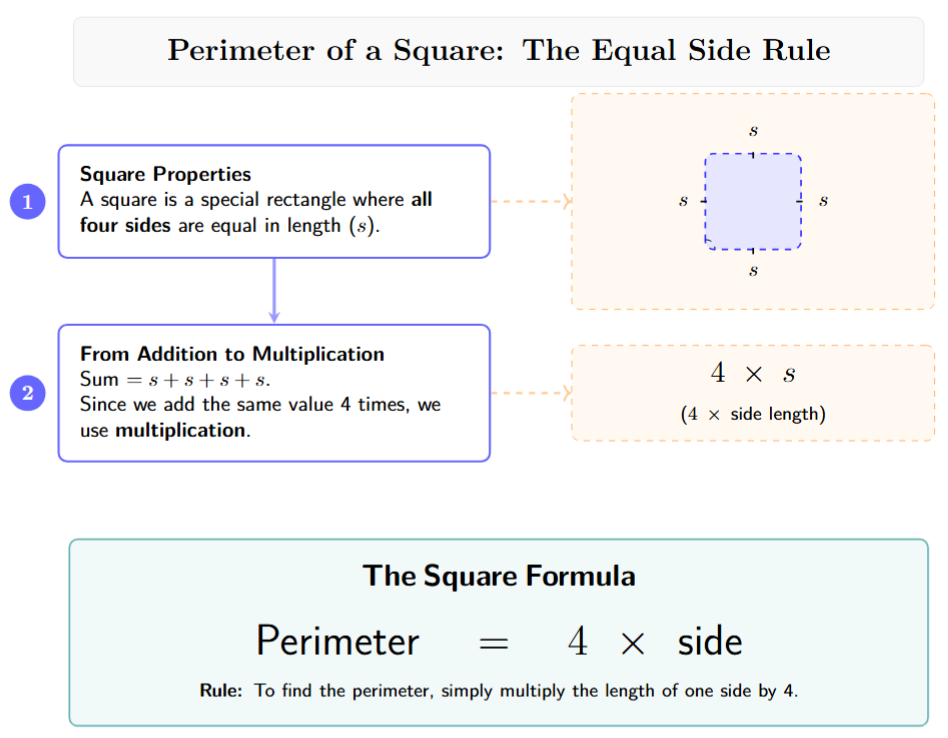
Let the length of each side of the square be denoted by $s$. Since all four sides are equal, the length of each side is $s$.
Using the general rule that perimeter is the sum of all side lengths, the perimeter of a square is:
Perimeter $= \text{side} + \text{side} + \text{side} + \text{side}$
$= s + s + s + s$
Since we are adding the same quantity ($s$) four times, this can be written as multiplication:
$= 4 \times s$
Thus, the formula for the perimeter of a square is:
$\text{Perimeter of a square} = 4 \times \text{side}$
This formula means that if you know the length of one side of a square, you can find its perimeter by multiplying that length by 4.
Perimeter of a Triangle
A triangle is the simplest possible polygon, having three sides and three angles. Triangles can vary greatly in the lengths of their sides:
- Scalene Triangle: All three sides have different lengths.
- Isosceles Triangle: Two sides have equal length.
- Equilateral Triangle: All three sides have equal length.
Regardless of the type of triangle, its perimeter is found by adding the lengths of its three sides.
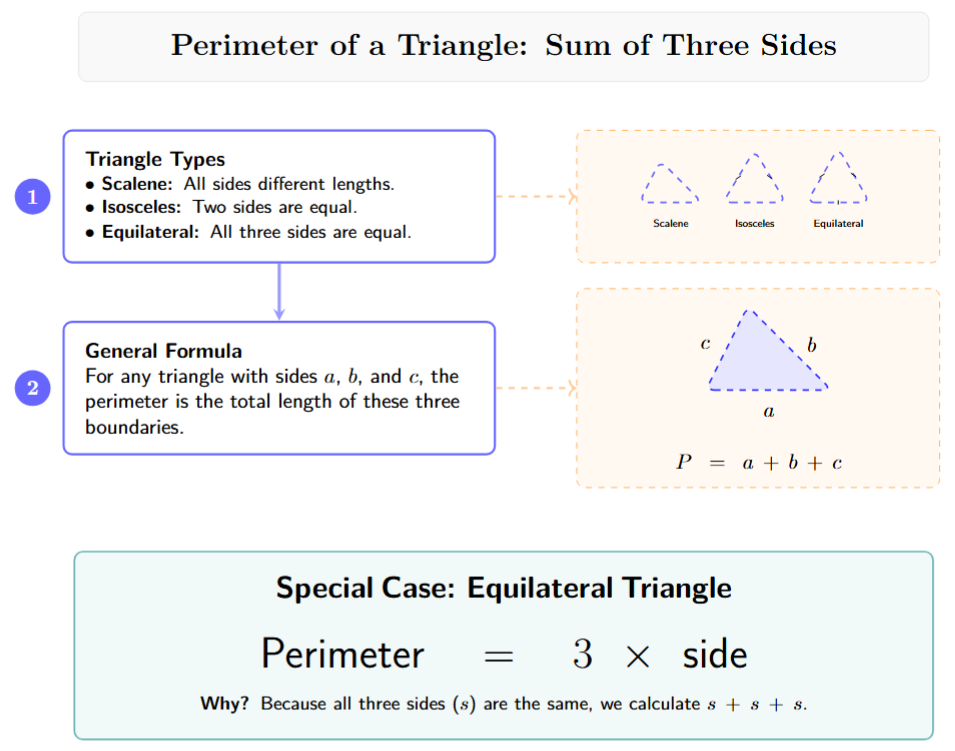
Let the lengths of the three sides of a triangle be $a, b,$ and $c$.
The perimeter of the triangle is the sum of the lengths of its three sides:
$\text{Perimeter of a triangle} = a + b + c$
For an equilateral triangle with side length $s$, the perimeter would be $s+s+s = 3 \times s$.
Perimeter of Other Polygons
The fundamental rule for finding the perimeter remains the same for any polygon, no matter how many sides it has: add up the lengths of all its sides.
Rule: The perimeter of any polygon = Sum of the lengths of all its sides.
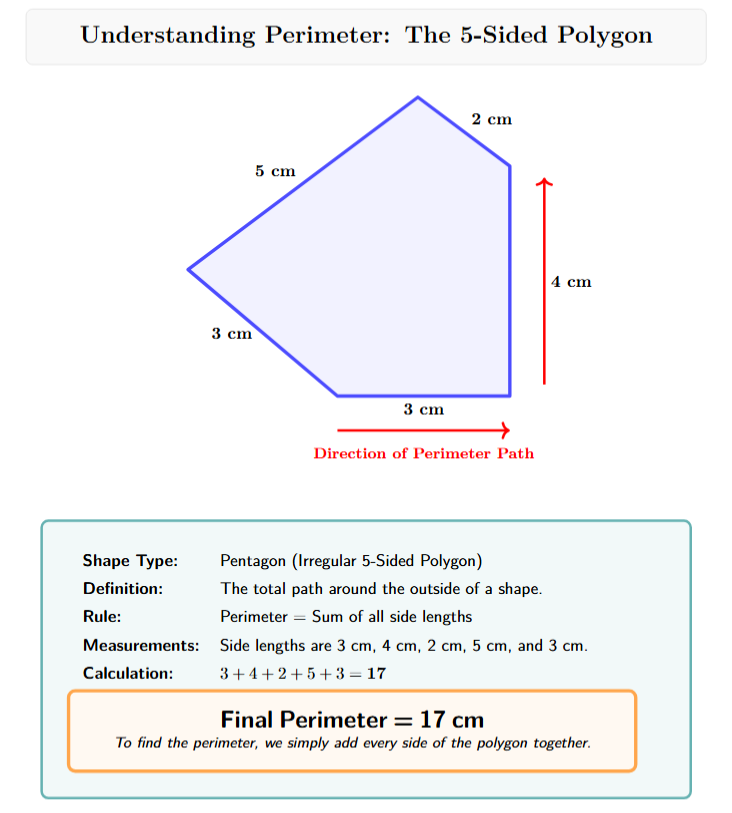
Example: Find the perimeter of a pentagon (a 5-sided polygon) with side lengths 3 cm, 4 cm, 2 cm, 5 cm, and 3 cm.
Perimeter $= 3 \text{ cm} + 4 \text{ cm} + 2 \text{ cm} + 5 \text{ cm} + 3 \text{ cm} = 17 \text{ cm}$.
Perimeter of a Regular Polygon
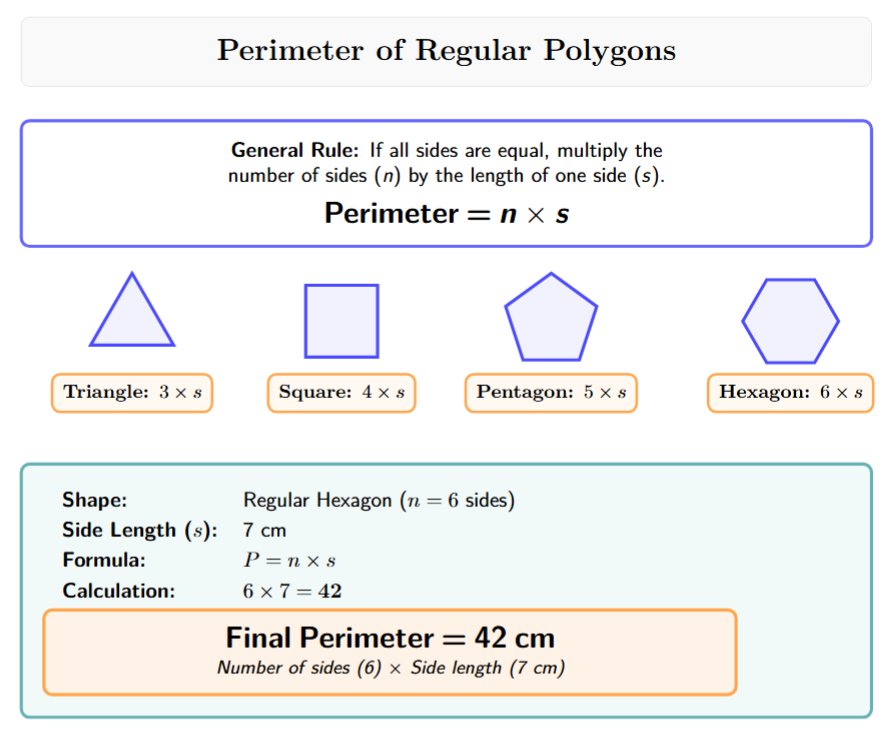
A regular polygon is a special type of polygon where all its sides are equal in length, and all its interior angles are equal in measure. Examples are an equilateral triangle (3 sides), a square (4 sides), a regular pentagon (5 sides), a regular hexagon (6 sides), a regular octagon (8 sides), and so on.
If a regular polygon has $n$ sides, and each side has a length denoted by $s$, then its perimeter can be calculated using a simple formula derived from the general rule. Since all $n$ sides have the same length $s$, the sum of the lengths is $s$ added to itself $n$ times.
$\text{Perimeter of a regular polygon} = \underbrace{s + s + s + ... + s}_{n \text{ times}}$
$= n \times s$
Thus, the formula for the perimeter of a regular polygon is:
$\text{Perimeter of a regular polygon} = \text{Number of sides} \times \text{Length of one side}$
$= n \times s$
Example: Find the perimeter of a regular hexagon (a 6-sided regular polygon) with a side length of 7 cm.
Here, the number of sides $n=6$, and the length of one side $s=7$ cm.
Perimeter $= n \times s = 6 \times 7 \text{ cm} = 42 \text{ cm}$.
Example 1. Find the perimeter of a rectangle whose length is 10 cm and breadth is 5 cm.
Answer:
We are given the dimensions of the rectangle:
Length ($l$) = 10 cm
Breadth ($b$) = 5 cm
We use the formula for the perimeter of a rectangle:
$\text{Perimeter} = 2 \times (l + b)$
Substitute the given values into the formula:
Perimeter $= 2 \times (10 \text{ cm} + 5 \text{ cm})$
First, perform the addition inside the parenthesis:
$= 2 \times (15 \text{ cm})$
Now, multiply by 2:
$= 30 \text{ cm}$
The perimeter of the rectangle is $30 \text{ cm}$.
Example 2. A square park has a side length of 50 metres. Find the perimeter of the park.
Answer:
We are given the side length ($s$) of the square park:
Side length, $s = 50 \text{ metres}$
We use the formula for the perimeter of a square:
$\text{Perimeter} = 4 \times s$
Substitute the given value into the formula:
Perimeter $= 4 \times 50 \text{ metres}$
Perform the multiplication:
$= 200 \text{ metres}$
The perimeter of the square park is $200 \text{ metres}$.
Example 3. Find the perimeter of a triangle with sides measuring 8 cm, 15 cm, and 17 cm.
Answer:
The side lengths of the triangle are given as $a=8$ cm, $b=15$ cm, and $c=17$ cm.
The formula for the perimeter of a triangle is the sum of its side lengths:
$\text{Perimeter} = a + b + c$
Substitute the given side lengths:
Perimeter $= 8 \text{ cm} + 15 \text{ cm} + 17 \text{ cm}$
Perform the addition:
$= (8 + 15) \text{ cm} + 17 \text{ cm}$
$= 23 \text{ cm} + 17 \text{ cm}$
$= 40 \text{ cm}$
The perimeter of the triangle is $40 \text{ cm}$.
Example 4. A rectangular field is 150 metres long and 100 metres wide. What is the total distance a person walks if they go around the field three times?
Answer:
First, we need to find the perimeter of the rectangular field.
Length ($l$) = 150 metres
Breadth ($b$) = 100 metres
Perimeter of the rectangular field $= 2 \times (l + b)$
Perimeter $= 2 \times (150 \text{ m} + 100 \text{ m})$
$= 2 \times (250 \text{ m})$
$= 500 \text{ metres}$
The perimeter of the field is 500 metres. This is the distance covered in one round.
The person walks around the field three times.
Total distance covered = Number of rounds $\times$ Perimeter of the field
Total distance $= 3 \times 500 \text{ metres}$
$= 1500 \text{ metres}$
The total distance walked by the person is $1500 \text{ metres}$.
Area of Plane Figures
In the previous section on Perimeter, we learned about the length of the boundary of a closed plane figure. Now, we will look at another important measurement related to plane figures: the amount of surface they cover. This measure is called the area. Mensuration deals with both the perimeter and the area (and later, volume for 3D shapes) of geometric figures.
What is Area?
The Area of a closed plane figure is the measure of the amount of flat surface enclosed within its boundary. Think of the surface of a table, the floor of a room, or the space covered by a piece of paper. The area tells us how much two-dimensional space a figure occupies.
Area is always measured in square units. This is because we are measuring a two-dimensional space (length $\times$ length). Common units of area include square centimetres ($cm^2$), square metres ($m^2$), square kilometres ($km^2$), etc. If the dimensions are in feet, the area is in square feet ($ft^2$).
Area on a Grid (Counting Squares)
One fundamental way to understand the concept of area is by visualising a figure placed on a grid made up of unit squares. A unit square is a square with a side length of 1 unit (e.g., 1 cm $\times$ 1 cm, 1 metre $\times$ 1 metre). The area of a unit square is 1 square unit ($1 \text{ unit}^2$).
To find the area of a figure on a grid, we can count the number of unit squares that the figure covers. This method works well for both regular shapes and irregular shapes, although for irregular shapes, it often provides an approximate area.
Here are the general rules for counting squares on a grid to estimate area:
- Count the number of full squares that are completely inside the boundary of the figure. Each full square counts as 1 square unit of area.
- Count the number of squares that are more than half covered by the figure. Each of these is usually counted as one full square (this is an approximation).
- Count the number of squares that are exactly half covered by the figure. Each half square counts as $\frac{1}{2}$ (or 0.5) square unit of area.
- Ignore the squares that are less than half covered by the figure.
The total area is the sum of the areas from the counts of these different types of squares.
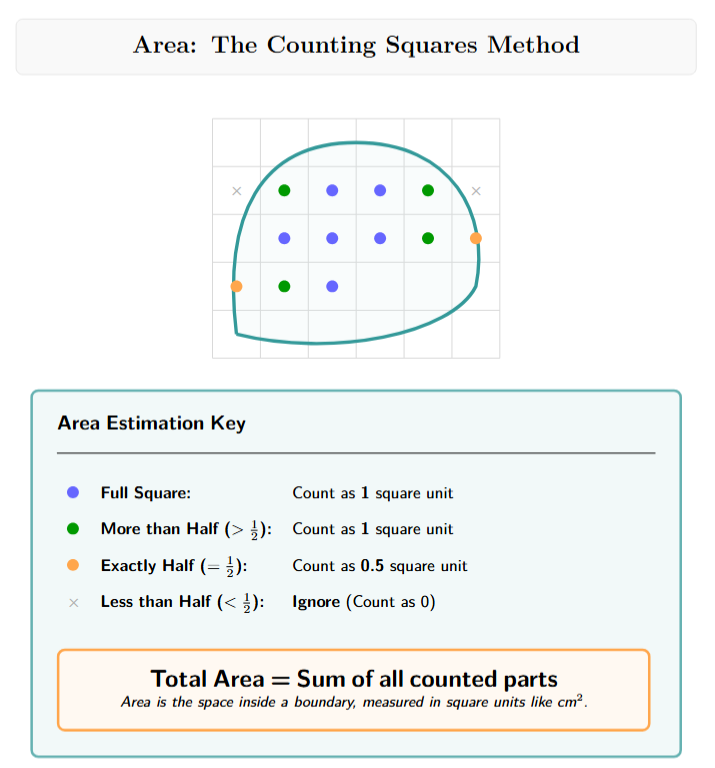
For irregular shapes, this method gives an estimation of the area. For regular shapes like rectangles and squares, counting squares on a grid leads directly to formulas for calculating the exact area.
Area of a Rectangle
Let's consider a rectangle with length '$l$' and breadth '$b$' placed on a grid of unit squares.
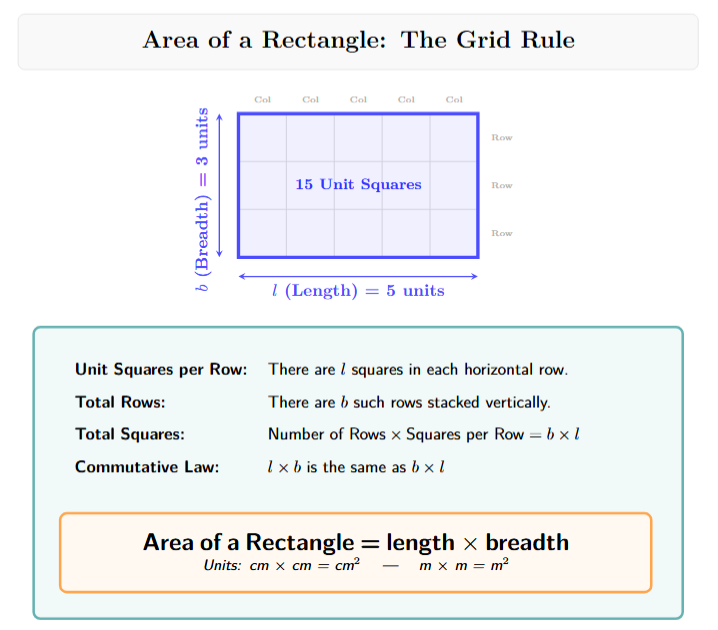
If the length of the rectangle is $l$ units and the breadth is $b$ units, we can think of the rectangle as being made up of $b$ rows of unit squares, with each row containing $l$ unit squares. Alternatively, it has $l$ columns of unit squares, with each column containing $b$ unit squares.
To find the total number of unit squares inside the rectangle, we can multiply the number of rows by the number of squares in each row, or the number of columns by the number of squares in each column.
Total number of unit squares = Number of rows $\times$ Number of squares per row
$= b \times l$
Or, Total number of unit squares = Number of columns $\times$ Number of squares per column
$= l \times b$
Since the area is measured by the number of unit squares covered, and the multiplication of numbers is commutative ($l \times b = b \times l$), the area of the rectangle is $l \times b$ square units.
Thus, the formula for the area of a rectangle is:
$\text{Area of a rectangle} = \text{length} \times \text{breadth}$
If the length and breadth are given in centimetres, the area will be in $cm^2$. If they are in metres, the area will be in $m^2$.
Area of a Square
A square is a special case of a rectangle where the length and the breadth are equal. Both dimensions are simply referred to as the side length, denoted by $s$.
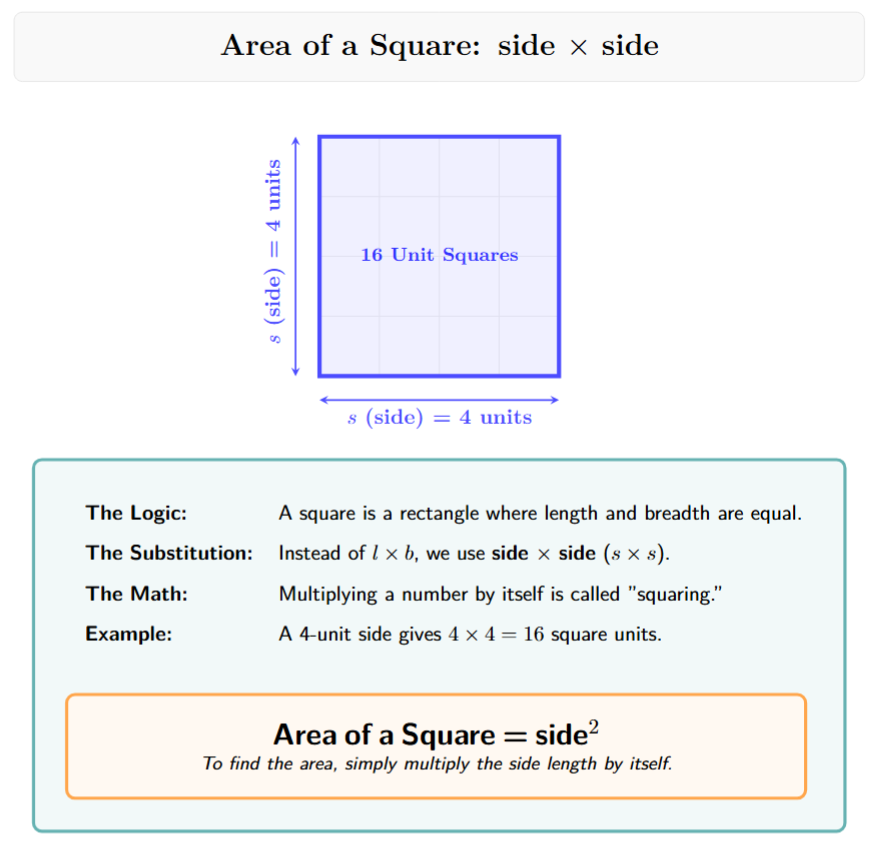
Using the formula for the area of a rectangle, $\text{Area} = \text{length} \times \text{breadth}$, we replace both 'length' and 'breadth' with 'side' ($s$) since they are equal in a square.
$\text{Area of a square} = \text{side} \times \text{side}$
$= s \times s$
This can be written using exponents as $s^2$ (s squared).
$\text{Area of a square} = s^2$
So, to find the area of a square, you multiply the length of one side by itself.
Example 1. Find the area of a rectangle whose length is 8 cm and breadth is 3 cm.
Answer:
We are given the dimensions of the rectangle:
Length ($l$) = 8 cm
Breadth ($b$) = 3 cm
Using the formula for the area of a rectangle:
$\text{Area} = l \times b$
Substitute the given values into the formula:
Area $= 8 \text{ cm} \times 3 \text{ cm}$
Perform the multiplication:
$= 24 \text{ cm} \times \text{cm}$
The unit for area is the square of the unit of length.
$= 24 \text{ square centimetres}$ or $24 \text{ cm}^2$
The area of the rectangle is $24 \text{ cm}^2$.
Example 2. A square field has a side length of 60 metres. Find the area of the field.
Answer:
We are given the side length ($s$) of the square field:
Side length, $s = 60 \text{ metres}$
Using the formula for the area of a square:
$\text{Area} = s \times s$
Substitute the given value into the formula:
Area $= 60 \text{ metres} \times 60 \text{ metres}$
Perform the multiplication:
$= (60 \times 60) \times (\text{metres} \times \text{metres})$
$= 3600 \times \text{metres}^2$
$= 3600 \text{ square metres}$ or $3600 \text{ m}^2$
The area of the square field is $3600 \text{ m}^2$.
Example 3. Find the area of a floor which is 20 metres long and 15 metres wide.
Answer:
The floor is rectangular in shape.
Length ($l$) = 20 metres
Width ($w$) = 15 metres
Using the formula for the area of a rectangle (using width instead of breadth as per the example's term):
$\text{Area} = l \times w$
Substitute the values:
Area $= 20 \text{ m} \times 15 \text{ m}$
Perform the multiplication:
$= (20 \times 15) \text{ m}^2$
$= 300 \text{ m}^2$
The area of the floor is $300 \text{ m}^2$.
Example 4. A square piece of cloth has a side length of 25 cm. What is its area?
Answer:
The cloth is square in shape.
Side length ($s$) = 25 cm
Using the formula for the area of a square:
$\text{Area} = s \times s$
Substitute the side length:
Area $= 25 \text{ cm} \times 25 \text{ cm}$
Perform the multiplication:
$= (25 \times 25) \text{ cm}^2$
$= 625 \text{ cm}^2$
The area of the square piece of cloth is $625 \text{ cm}^2$.