

Chapter 5 Lines and Angles (Concepts)
Embark on this essential geometrical journey as we delve into the fundamental concepts of Lines and Angles, exploring their definitions, classifications, and the predictable relationships they form. This chapter commences with a reaffirmation of basic geometric elements: the dimensionless point, the infinitely extending line, the precisely delimited line segment, and the directional ray. A robust understanding of these foundational components is prerequisite to comprehending their interactions within more complex geometric structures.
Our primary focus then transitions to angles, defined as the geometric figure formed by two rays sharing a common endpoint, the vertex. We will systematically categorize angles based on their magnitude, distinguishing between Acute, Right, Obtuse, Straight, and Reflex Angles. Furthermore, we will investigate the critical relationships between pairs of angles, such as Complementary, Supplementary, Adjacent, Linear Pair, and Vertically Opposite Angles. A significant segment of this chapter is dedicated to the intricate angle relationships formed when a transversal intersects parallel lines, including Corresponding, Alternate Interior/Exterior, and Consecutive Interior Angles. This foundational knowledge is pivotal for advanced geometric problem-solving.
To facilitate comprehensive understanding, this page incorporates visualizations, flowcharts, mind maps, and practical examples of concepts. These resources are designed to clarify the definitions, classifications, and interactive properties of lines and angles, preparing students for more advanced geometrical studies. This comprehensive resource has been expertly developed by learningspot.co.
| Content On This Page | ||
|---|---|---|
| Related Angles | Pair of Lines & Angles Formed by Transversal | |
Related Angles
In geometry, an angle is formed when two rays or lines meet at a common point called the vertex. We classify angles based on their measure (e.g., acute, right, obtuse, straight, reflex angles). However, angles often appear in pairs or groups, and these pairs can have special relationships based on how their measures combine or how they are positioned relative to each other. Understanding these relationships between angles is crucial for solving geometric problems and proving theorems.
1. Complementary Angles
Two angles are defined as Complementary Angles if the sum of their measures is exactly $90^\circ$.
If $\angle A$ and $\angle B$ are complementary angles, then the measure of angle A plus the measure of angle B is equal to $90^\circ$.
$m\angle A + m\angle B = 90^\circ $
When two angles are complementary, each angle is called the Complement of the other angle.
Examples:
- If an angle measures $30^\circ$, its complement measures $90^\circ - 30^\circ = 60^\circ$. ($30^\circ$ and $60^\circ$ are complementary angles).
- If an angle measures $45^\circ$, its complement measures $90^\circ - 45^\circ = 45^\circ$. ($45^\circ$ is its own complement).
- If an angle measures $70^\circ$, its complement measures $90^\circ - 70^\circ = 20^\circ$.
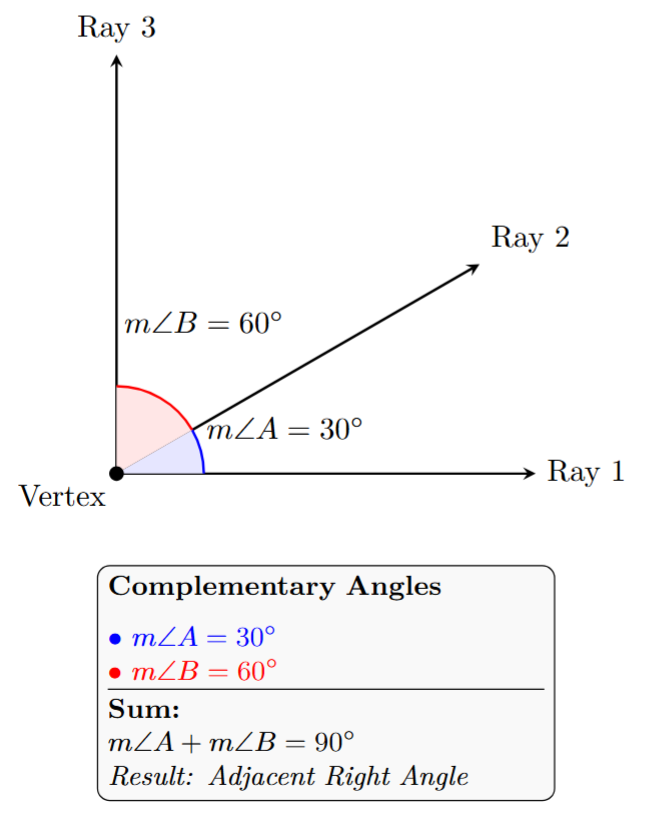
Complementary angles can be adjacent (sharing a vertex and an arm, forming a right angle together) or non-adjacent (located separately but their measures add up to $90^\circ$). The figure above shows adjacent complementary angles.
Finding the Complement of an Angle:
To find the complement of a given angle, subtract the measure of the given angle from $90^\circ$.
Complement of $\theta = 90^\circ - \theta $
2. Supplementary Angles
Two angles are defined as Supplementary Angles if the sum of their measures is exactly $180^\circ$.
If $\angle X$ and $\angle Y$ are supplementary angles, then the measure of angle X plus the measure of angle Y is equal to $180^\circ$.
$m\angle X + m\angle Y = 180^\circ $
When two angles are supplementary, each angle is called the Supplement of the other angle.
Examples:
- If an angle measures $110^\circ$, its supplement measures $180^\circ - 110^\circ = 70^\circ$. ($110^\circ$ and $70^\circ$ are supplementary angles).
- If an angle measures $90^\circ$, its supplement measures $180^\circ - 90^\circ = 90^\circ$. (A right angle's supplement is another right angle).
- If an angle measures $40^\circ$, its supplement measures $180^\circ - 40^\circ = 140^\circ$.
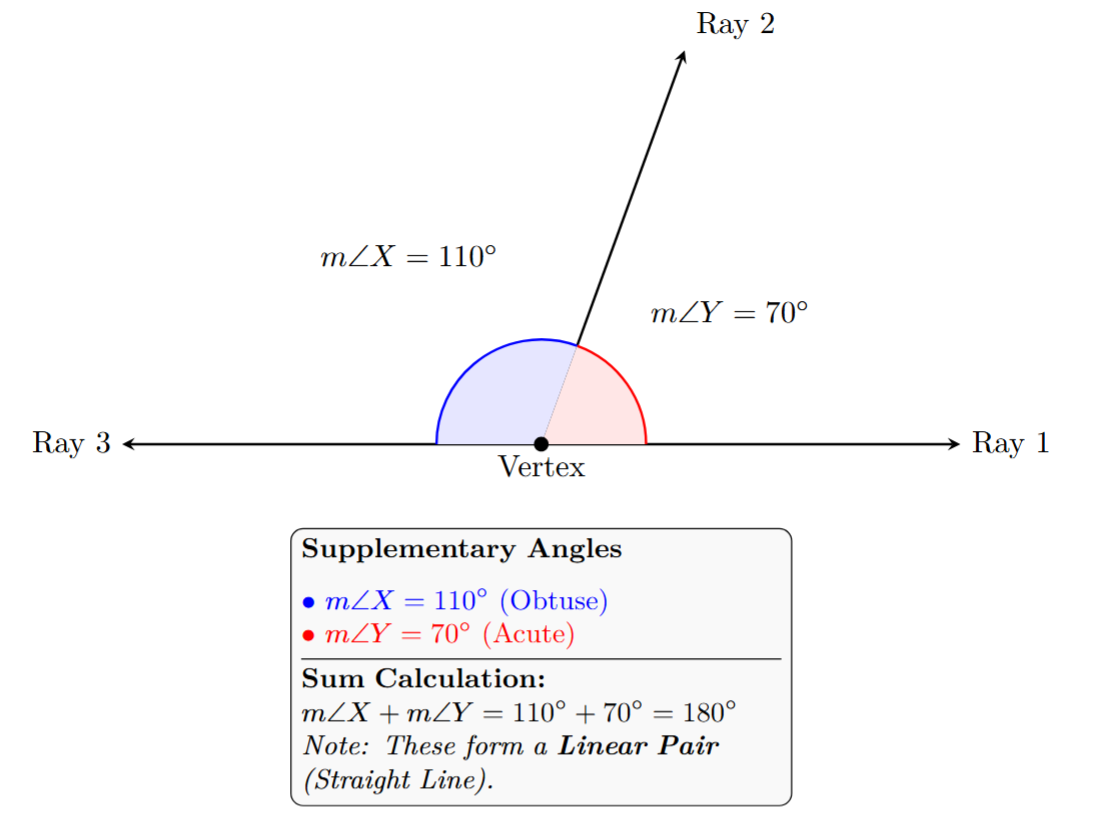
Supplementary angles can also be adjacent (sharing a vertex and an arm, forming a straight line together - this is called a linear pair) or non-adjacent (located separately but their measures add up to $180^\circ$). The figure above shows adjacent supplementary angles.
Finding the Supplement of an Angle:
To find the supplement of a given angle, subtract the measure of the given angle from $180^\circ$.
Supplement of $\theta = 180^\circ - \theta $
3. Adjacent Angles
Adjacent Angles are a pair of angles that are 'next to' each other. For two angles to be considered adjacent, they must meet specific conditions regarding their vertex and arms:
Two angles are called adjacent angles if they satisfy all three of the following conditions:
- They have a common vertex (the point where the rays meet).
- They share a common arm (one of the rays forming the angles is common to both angles).
- Their non-common arms (the other two rays) lie on opposite sides of the common arm.
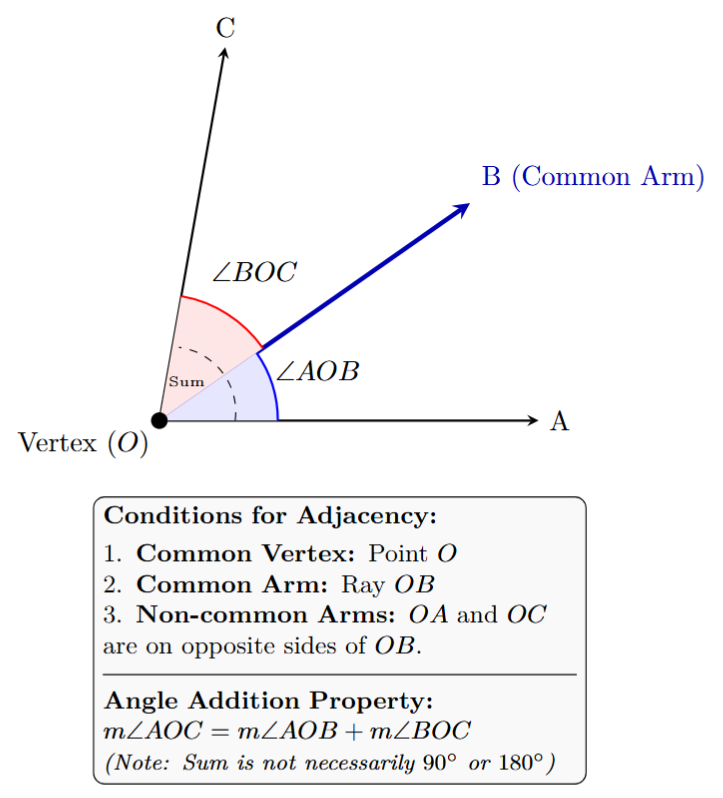
In the figure above, $\angle AOB$ and $\angle BOC$ are adjacent angles. They meet at common vertex O, share the common arm OB, and the non-common arms OA and OC are on opposite sides of OB.
Note that the sum of adjacent angles is not always $90^\circ$ or $180^\circ$. The sum of adjacent angles is equal to the measure of the larger angle formed by their non-common arms (i.e., $m\angle AOC = m\angle AOB + m\angle BOC$ in the figure).
4. Linear Pair of Angles
A Linear Pair is a special type of adjacent angles. A linear pair consists of two adjacent angles whose non-common arms are opposite rays. Opposite rays are two rays that start from the same point and extend in opposite directions, forming a straight line.
When two adjacent angles form a straight line, they form a linear pair.
The most important property of a linear pair is that the sum of the measures of the two angles in a linear pair is always $180^\circ$. Therefore, angles forming a linear pair are always supplementary.
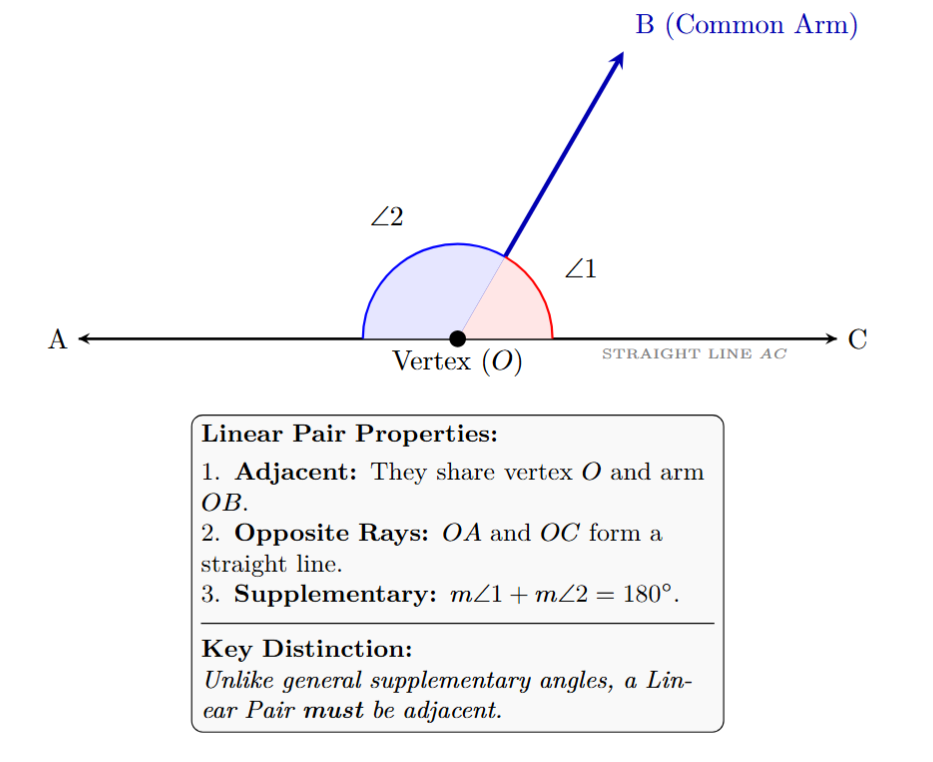
In the figure, $\angle 1$ and $\angle 2$ are adjacent angles sharing vertex O and common arm OB. Their non-common arms, OA and OC, are opposite rays forming the straight line AC. Thus, $\angle 1$ and $\angle 2$ form a linear pair, and $m\angle 1 + m\angle 2 = 180^\circ$.
Key Difference between Supplementary Angles and Linear Pair:
- All angles that form a linear pair are supplementary (their sum is $180^\circ$).
- However, not all supplementary angles form a linear pair. Supplementary angles only form a linear pair if they are also adjacent angles whose non-common arms form a straight line. Two separate angles measuring $100^\circ$ and $80^\circ$ are supplementary, but they do not form a linear pair unless placed adjacent to each other such that their outer arms form a straight line.
5. Vertically Opposite Angles
When two straight lines intersect each other at a point, they form two pairs of angles opposite to each other at the intersection point. These pairs of angles are called Vertically Opposite Angles (sometimes just called vertical angles).
Vertically opposite angles share a common vertex (the point of intersection), but they do not share any common arm. They are formed by opposite rays.
The key property of vertically opposite angles is that they are always equal in measure.
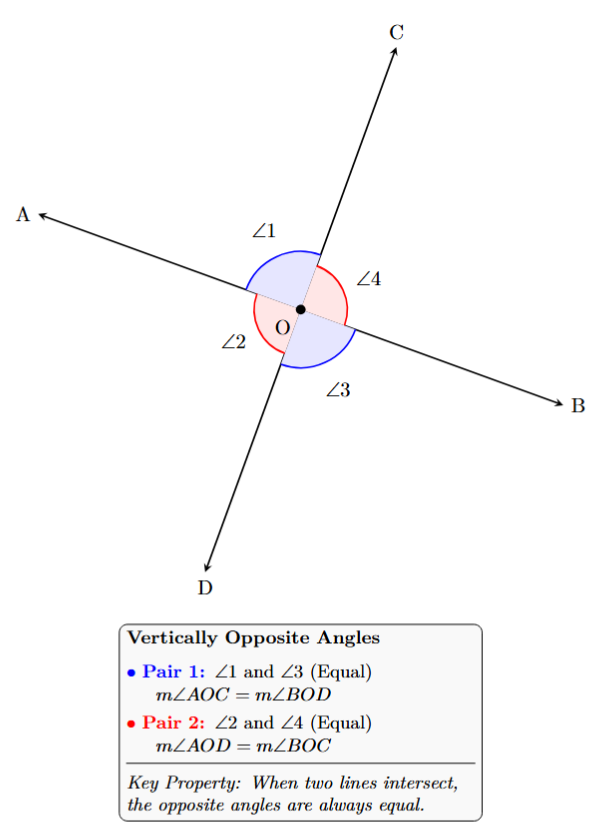
In the figure above, lines AB and CD intersect at point O.
- $\angle 1$ (or $\angle$ AOC) and $\angle 3$ (or $\angle$ BOD) form one pair of vertically opposite angles. Therefore, $m\angle 1 = m\angle 3$.
- $\angle 2$ (or $\angle$ AOD) and $\angle 4$ (or $\angle$ BOC) form another pair of vertically opposite angles. Therefore, $m\angle 2 = m\angle 4$.
Proof that vertically opposite angles are equal:
Consider two lines AB and CD intersecting at point O, forming angles $\angle 1, \angle 2, \angle 3, \angle 4$ as shown in the figure above.
Given: Lines AB and CD intersect at O.
To Prove: (i) $m\angle 1 = m\angle 3$ and (ii) $m\angle 2 = m\angle 4$.
Proof:
Consider line CD. Ray OA stands on the line CD. Therefore, $\angle 1$ and $\angle 2$ are adjacent angles and their non-common arms (OC and OA) form a straight line (CD is a straight line). This means $\angle 1$ and $\angle 2$ form a linear pair.
$m\angle 1 + m\angle 2 = 180^\circ$
[Linear pair property] ... (i)
Now consider line AB. Ray OD stands on the line AB. Therefore, $\angle 2$ and $\angle 3$ are adjacent angles and their non-common arms (OA and OD) form a straight line (AB is a straight line). This means $\angle 2$ and $\angle 3$ form a linear pair.
$m\angle 2 + m\angle 3 = 180^\circ$
[Linear pair property] ... (ii)
From equations (i) and (ii), both $(m\angle 1 + m\angle 2)$ and $(m\angle 2 + m\angle 3)$ are equal to $180^\circ$. Therefore, they are equal to each other.
$m\angle 1 + m\angle 2 = m\angle 2 + m\angle 3$
Subtract $m\angle 2$ from both sides of this equation:
$m\angle 1 = m\angle 3$
This proves that vertically opposite angles $\angle 1$ and $\angle 3$ are equal.
Similarly, we can prove that $m\angle 2 = m\angle 4$. For example, $\angle 2$ and $\angle 3$ form a linear pair ($m\angle 2 + m\angle 3 = 180^\circ$) (from equation (ii)). Also, $\angle 3$ and $\angle 4$ form a linear pair ($m\angle 3 + m\angle 4 = 180^\circ$). Equating these: $m\angle 2 + m\angle 3 = m\angle 3 + m\angle 4$. Subtracting $m\angle 3$ from both sides gives $m\angle 2 = m\angle 4$.
Hence, vertically opposite angles are equal in measure.
Example 1. Find the complement of an angle of $35^\circ$.
Answer:
Let the given angle be $\theta = 35^\circ$.
We know that two angles are complementary if the sum of their measures is $90^\circ$.
Let the complement of $35^\circ$ be $\phi$.
Then, $\theta + \phi = 90^\circ$.
Substitute the given angle measure:
$35^\circ + \phi = 90^\circ $
To find $\phi$, subtract $35^\circ$ from $90^\circ$:
$\phi = 90^\circ - 35^\circ $
$\phi = 55^\circ $
Therefore, the complement of an angle of $35^\circ$ is $55^\circ$.
Example 2. Two angles are supplementary. If one angle is $80^\circ$, find the other angle.
Answer:
Let the two supplementary angles be $\alpha$ and $\beta$.
We are given that one angle is $80^\circ$. Let's say $\alpha = 80^\circ$.
We know that two angles are supplementary if the sum of their measures is $180^\circ$.
So, $\alpha + \beta = 180^\circ$.
Substitute the given angle measure:
$80^\circ + \beta = 180^\circ $
To find $\beta$, subtract $80^\circ$ from $180^\circ$:
$\beta = 180^\circ - 80^\circ $
$\beta = 100^\circ $
Therefore, the other angle is $100^\circ$.
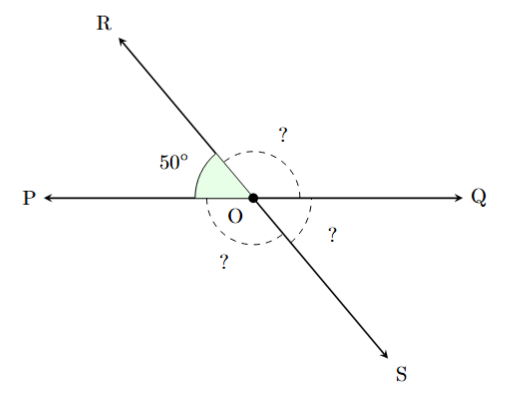
Example 3. In the given figure, lines PQ and RS intersect at point O. If $m\angle POR = 50^\circ$, find $m\angle POS$, $m\angle SOQ$, and $m\angle ROQ$.
Answer:
Given: Lines PQ and RS intersect at point O. We are given that $m\angle POR = 50^\circ$.
From the figure and the definitions of related angles, we can find the measures of the other angles.
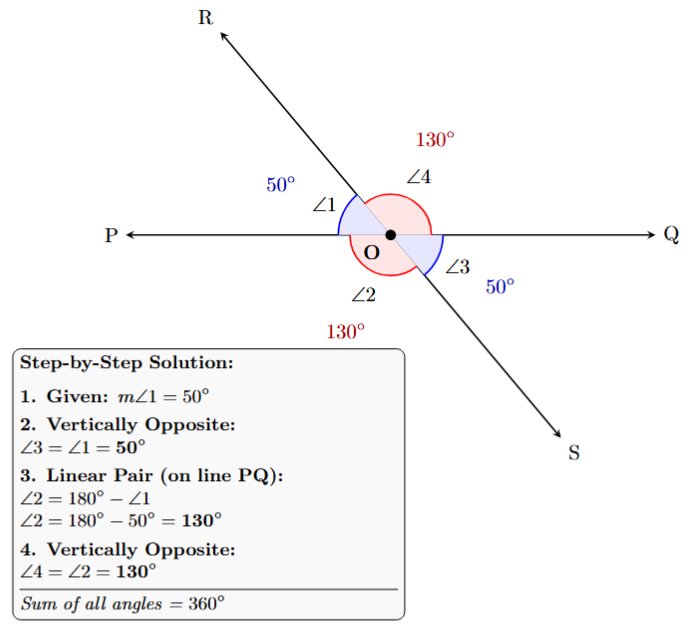
Let's denote the angles: $\angle POR = \angle 1$, $\angle POS = \angle 2$, $\angle SOQ = \angle 3$, $\angle ROQ = \angle 4$. We are given $m\angle 1 = 50^\circ$.
1. Find $m\angle SOQ$ (or $m\angle 3$):
Observe that $\angle POR$ ($\angle 1$) and $\angle SOQ$ ($\angle 3$) are angles formed opposite to each other at the intersection point O by lines PQ and RS. These are vertically opposite angles.
We know that vertically opposite angles are equal in measure.
$m\angle SOQ = m\angle POR$
[Vertically opposite angles are equal]
$m\angle SOQ = 50^\circ $.
2. Find $m\angle POS$ (or $m\angle 2$):
Consider the straight line PQ. Ray OS stands on line PQ. Therefore, the adjacent angles $\angle POR$ ($\angle 1$) and $\angle POS$ ($\angle 2$) form a linear pair.
The sum of angles in a linear pair is $180^\circ$.
$m\angle POR + m\angle POS = 180^\circ$
[Angles forming a linear pair]
Substitute the given value $m\angle POR = 50^\circ$:
$50^\circ + m\angle POS = 180^\circ$
To find $m\angle POS$, subtract $50^\circ$ from $180^\circ$:
$m\angle POS = 180^\circ - 50^\circ $
$m\angle POS = 130^\circ $.
3. Find $m\angle ROQ$ (or $m\angle 4$):
Observe that $\angle POS$ ($\angle 2$) and $\angle ROQ$ ($\angle 4$) are vertically opposite angles.
Since vertically opposite angles are equal in measure,
$m\angle ROQ = m\angle POS$
[Vertically opposite angles are equal]
$m\angle ROQ = 130^\circ $.
Alternatively, we could have noted that $\angle SOQ$ ($\angle 3$) and $\angle ROQ$ ($\angle 4$) form a linear pair on the straight line RS. Thus $m\angle SOQ + m\angle ROQ = 180^\circ$. Since $m\angle SOQ = 50^\circ$, we get $50^\circ + m\angle ROQ = 180^\circ$, which also gives $m\angle ROQ = 130^\circ$.
The measures of the angles are: $m\angle POS = 130^\circ$, $m\angle SOQ = 50^\circ$, and $m\angle ROQ = 130^\circ$.
Pair of Lines & Angles Formed by Transversal
In geometry, we study different types of lines and how they interact. Lines in a plane can be related in specific ways. When a third line cuts across two or more other lines, it creates a set of angles with unique relationships, especially if the original lines are parallel. Understanding these relationships is crucial for solving geometric problems.
Pairs of Lines
When we consider two distinct straight lines in the same plane, there are two possibilities for their relationship:
1. Intersecting Lines
Two distinct lines in a plane are called Intersecting Lines if they cross each other at exactly one common point. This point where the lines cross is known as the Point of Intersection.
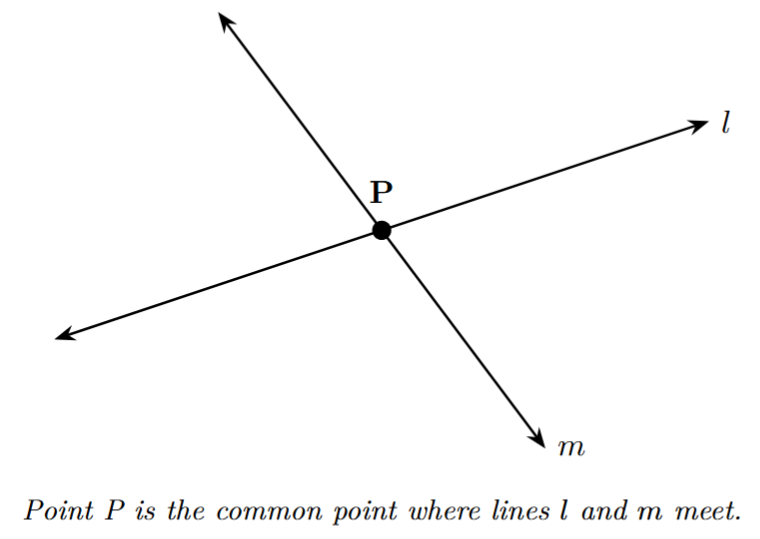
In the figure, line $l$ and line $m$ intersect at the point P. As we saw in the previous section, when two lines intersect, they form pairs of vertically opposite angles (which are equal) and pairs of adjacent angles that form linear pairs (which are supplementary, summing to $180^\circ$).
2. Parallel Lines
Two distinct lines in a plane are said to be Parallel Lines if they never intersect each other, no matter how far they are extended in both directions. Parallel lines maintain a constant perpendicular distance between them at all points.
The symbol for parallel is $||$. If line $l$ is parallel to line $m$, we write it as $l \ || \ m$.
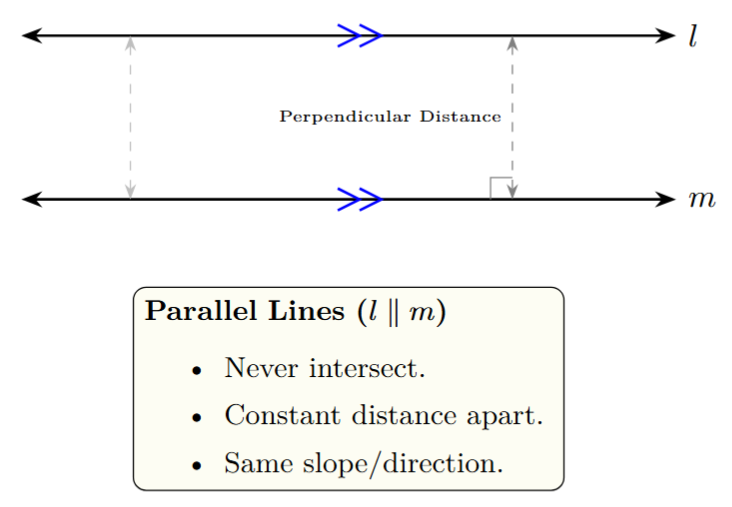
Examples of parallel lines are opposite edges of a ruler, railway tracks (ideally), opposite sides of a rectangle, etc.
Transversal
A Transversal is a straight line that intersects two or more distinct lines at distinct points.
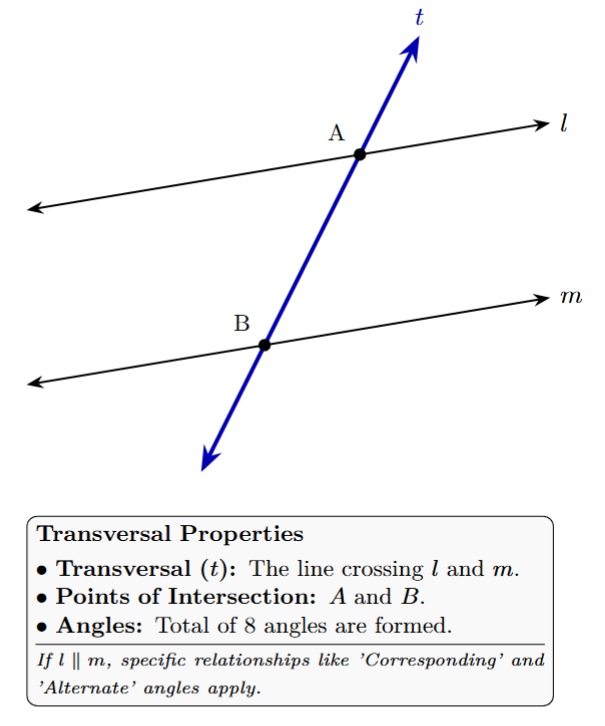
In the figure, line $t$ is a transversal to lines $l$ and $m$. The transversal $t$ intersects line $l$ at one point and line $m$ at a different point. When a transversal intersects two lines, it creates a total of eight angles, four at each intersection point.
These eight angles have specific names and relationships depending on their positions relative to the two lines ($l$ and $m$) and the transversal ($t$). These relationships become particularly significant when the lines $l$ and $m$ are parallel.
Angles Formed by a Transversal with Two Lines
Consider two lines $l$ and $m$ intersected by a transversal $t$. The eight angles formed are typically numbered as shown in the figure below:
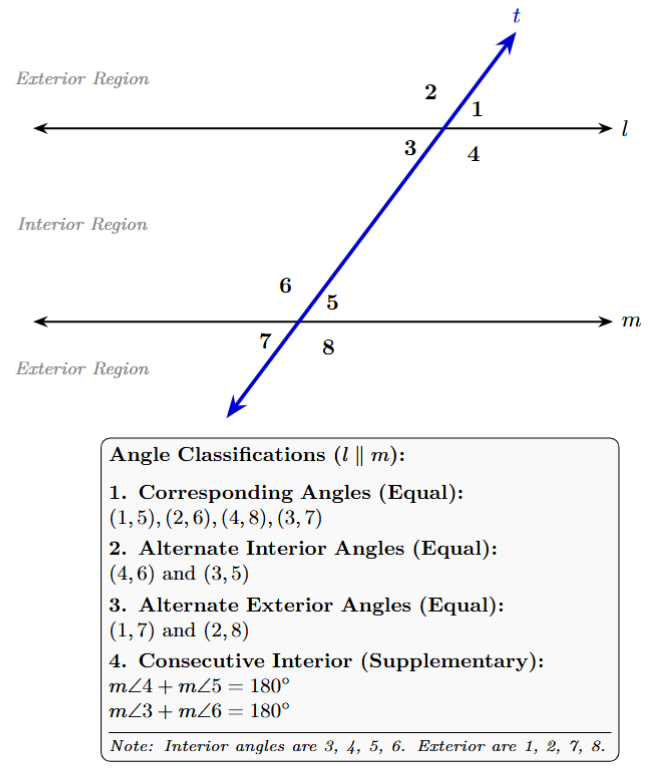
Based on their location, these eight angles can be classified:
- Interior Angles: These are the angles that lie in the region between the two lines $l$ and $m$.
In the figure: $\angle 3, \angle 4, \angle 5, \angle 6$ are the interior angles.
- Exterior Angles: These are the angles that lie in the region outside the two lines $l$ and $m$.
In the figure: $\angle 1, \angle 2, \angle 7, \angle 8$ are the exterior angles.
Based on their relative positions with respect to the transversal and the two lines, these angles form special pairs:
1. Corresponding Angles
Corresponding Angles are pairs of angles that are in the same relative position at each intersection point. One angle is exterior, the other is interior, and they are on the same side of the transversal.
Pairs of corresponding angles in the figure:
- $(\angle 1, \angle 5)$: Both are on the upper left corner of the intersections.
- $(\angle 2, \angle 6)$: Both are on the upper right corner.
- $(\angle 4, \angle 8)$: Both are on the lower right corner.
- $(\angle 3, \angle 7)$: Both are on the lower left corner.
Property: If lines $l$ and $m$ are parallel ($l \ || \ m$), then the corresponding angles are equal in measure. Conversely, if any pair of corresponding angles is equal, then lines $l$ and $m$ must be parallel.
If $l \ || \ m$, then $m\angle 1 = m\angle 5$, $m\angle 2 = m\angle 6$, $m\angle 4 = m\angle 8$, $m\angle 3 = m\angle 7$.
2. Alternate Interior Angles
Alternate Interior Angles are pairs of interior angles that are on opposite sides of the transversal. They are "alternating" across the transversal and are located "inside" the two lines.
Pairs of alternate interior angles in the figure:
- $(\angle 4, \angle 6)$: Both are interior and on opposite sides of $t$.
- $(\angle 3, \angle 5)$: Both are interior and on opposite sides of $t$.
Property: If lines $l$ and $m$ are parallel ($l \ || \ m$), then the alternate interior angles are equal in measure. Conversely, if any pair of alternate interior angles is equal, then lines $l$ and $m$ must be parallel.
If $l \ || \ m$, then $m\angle 4 = m\angle 6$ and $m\angle 3 = m\angle 5$.
3. Alternate Exterior Angles
Alternate Exterior Angles are pairs of exterior angles that are on opposite sides of the transversal.
Pairs of alternate exterior angles in the figure:
- $(\angle 1, \angle 7)$: Both are exterior and on opposite sides of $t$.
- $(\angle 2, \angle 8)$: Both are exterior and on opposite sides of $t$.
Property: If lines $l$ and $m$ are parallel ($l \ || \ m$), then the alternate exterior angles are equal in measure. Conversely, if any pair of alternate exterior angles is equal, then lines $l$ and $m$ must be parallel.
If $l \ || \ m$, then $m\angle 1 = m\angle 7$ and $m\angle 2 = m\angle 8$.
4. Interior Angles on the Same Side of the Transversal (Consecutive Interior Angles or Co-interior Angles)
These are pairs of interior angles that are located on the same side of the transversal.
Pairs of interior angles on the same side of the transversal in the figure:
- $(\angle 4, \angle 5)$: Both are interior and on the right side of $t$.
- $(\angle 3, \angle 6)$: Both are interior and on the left side of $t$.
Property: If lines $l$ and $m$ are parallel ($l \ || \ m$), then the interior angles on the same side of the transversal are supplementary (their sum is $180^\circ$). Conversely, if any pair of interior angles on the same side of the transversal is supplementary, then lines $l$ and $m$ must be parallel.
If $l \ || \ m$, then $m\angle 4 + m\angle 5 = 180^\circ$ and $m\angle 3 + m\angle 6 = 180^\circ$.
Properties Related to Parallel Lines
The relationships defined above are very important. They serve as conditions that are met when two lines are parallel, and conversely, they can be used as tests to determine if two lines are parallel.
Summary (when lines $l$ and $m$ are parallel, and $t$ is a transversal):
- Corresponding Angles are Equal.
- Alternate Interior Angles are Equal.
- Alternate Exterior Angles are Equal.
- Interior Angles on the Same Side of the Transversal are Supplementary (sum is $180^\circ$).
The converses of these statements are used to prove lines are parallel. For example, if you find that a pair of alternate interior angles formed by a transversal cutting two lines is equal, you can conclude that the two lines are parallel.
Checking for Parallel Lines (Conditions of Parallelism)
The properties mentioned above have converses that are used as tests to determine if two lines are parallel. If a transversal intersects two lines and any one of the following conditions is true, then the two lines must be parallel.
1. Converse of Corresponding Angles Axiom
If a transversal intersects two lines such that a pair of corresponding angles is equal, then the two lines are parallel.
If $\angle 1 = \angle 5$ (or any other pair of corresponding angles are equal), then $l \ || \ m$.
2. Converse of Alternate Interior Angles Theorem
If a transversal intersects two lines such that a pair of alternate interior angles is equal, then the two lines are parallel.
If $\angle 3 = \angle 5$ or $\angle 4 = \angle 6$, then $l \ || \ m$.
3. Converse of Consecutive Interior Angles Theorem
If a transversal intersects two lines such that a pair of interior angles on the same side of the transversal is supplementary (adds up to $180^\circ$), then the two lines are parallel.
If $\angle 3 + \angle 6 = 180^\circ$ or $\angle 4 + \angle 5 = 180^\circ$, then $l \ || \ m$.
Summary Table
| Condition | Property if lines are parallel ($l \ || \ m$) | Test to prove lines are parallel |
|---|---|---|
| Corresponding Angles | Angles are equal ($\angle 1 = \angle 5$) | If angles are equal, then lines are parallel. |
| Alternate Interior Angles | Angles are equal ($\angle 4 = \angle 6$) | If angles are equal, then lines are parallel. |
| Consecutive Interior Angles | Angles are supplementary ($\angle 4 + \angle 5 = 180^\circ$) | If angles are supplementary, then lines are parallel. |
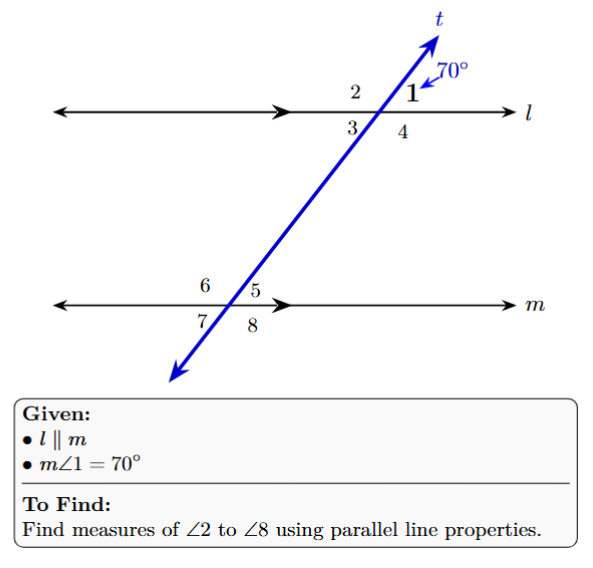
Example 1. In the given figure, $l \ || \ m$ and $t$ is a transversal. If $m\angle 1 = 70^\circ$, find the measure of all other angles ($\angle 2, \angle 3, \angle 4, \angle 5, \angle 6, \angle 7, \angle 8$).
Answer:
Given: Line $l$ is parallel to line $m$ ($l \ || \ m$), line $t$ is a transversal, and $m\angle 1 = 70^\circ$.
We can find the measures of the other angles using the properties of angles formed by a transversal and the relationships between adjacent and vertically opposite angles.
1. $m\angle 1 = 70^\circ$ (Given).
2. $\angle 1$ and $\angle 2$ form a linear pair (they are adjacent and on a straight line). The sum of angles in a linear pair is $180^\circ$.
$m\angle 1 + m\angle 2 = 180^\circ$
[Linear pair]
Substitute $m\angle 1 = 70^\circ$:
$70^\circ + m\angle 2 = 180^\circ $
Subtract $70^\circ$ from both sides:
$m\angle 2 = 180^\circ - 70^\circ = 110^\circ $.
So, $m\angle 2 = 110^\circ$.
3. $\angle 1$ and $\angle 3$ are vertically opposite angles. Vertically opposite angles are equal.
$m\angle 3 = m\angle 1$
[Vertically opposite angles]
So, $m\angle 3 = 70^\circ$.
4. $\angle 2$ and $\angle 4$ are vertically opposite angles. Vertically opposite angles are equal.
$m\angle 4 = m\angle 2$
[Vertically opposite angles]
So, $m\angle 4 = 110^\circ$.
Now we use the properties related to parallel lines $l$ and $m$ being intersected by transversal $t$ to find the angles at the second intersection.
5. $\angle 1$ and $\angle 5$ are corresponding angles. Since $l \ || \ m$, corresponding angles are equal.
$m\angle 5 = m\angle 1$
[Corresponding angles]
So, $m\angle 5 = 70^\circ$.
(Alternatively, $\angle 3$ and $\angle 5$ are alternate interior angles. Since $l \ || \ m$, alternate interior angles are equal. $m\angle 5 = m\angle 3 = 70^\circ$.)
6. $\angle 2$ and $\angle 6$ are corresponding angles. Since $l \ || \ m$, corresponding angles are equal.
$m\angle 6 = m\angle 2$
[Corresponding angles]
So, $m\angle 6 = 110^\circ$.
(Alternatively, $\angle 4$ and $\angle 6$ are alternate interior angles. Since $l \ || \ m$, alternate interior angles are equal. $m\angle 6 = m\angle 4 = 110^\circ$.)
(Or, using linear pair: $\angle 5$ and $\angle 6$ form a linear pair. $m\angle 5 + m\angle 6 = 180^\circ \Rightarrow 70^\circ + m\angle 6 = 180^\circ \Rightarrow m\angle 6 = 110^\circ$.)
7. $\angle 5$ and $\angle 7$ are vertically opposite angles. Vertically opposite angles are equal.
$m\angle 7 = m\angle 5$
[Vertically opposite angles]
So, $m\angle 7 = 70^\circ$.
(Alternatively, $\angle 3$ and $\angle 7$ are corresponding angles. Since $l \ || \ m$, corresponding angles are equal. $m\angle 7 = m\angle 3 = 70^\circ$.)
8. $\angle 6$ and $\angle 8$ are vertically opposite angles. Vertically opposite angles are equal.
$m\angle 8 = m\angle 6$
[Vertically opposite angles]
So, $m\angle 8 = 110^\circ$.
(Alternatively, $\angle 4$ and $\angle 8$ are corresponding angles. Since $l \ || \ m$, corresponding angles are equal. $m\angle 8 = m\angle 4 = 110^\circ$.)
Summary of angle measures:
Starting with $m\angle 1 = 70^\circ$, and using the properties, we found:
- $m\angle 2 = 110^\circ$
- $m\angle 3 = 70^\circ$
- $m\angle 4 = 110^\circ$
- $m\angle 5 = 70^\circ$
- $m\angle 6 = 110^\circ$
- $m\angle 7 = 70^\circ$
- $m\angle 8 = 110^\circ$
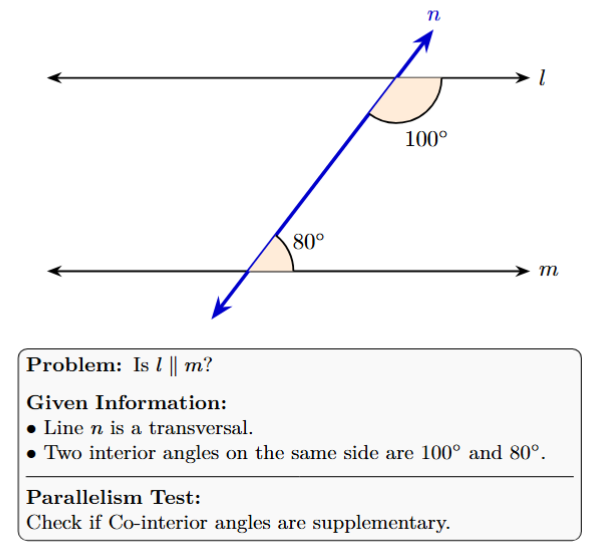
Example 2. In the given figure, decide whether line $l$ is parallel to line $m$. Give reason.
Answer:
The figure shows two lines $l$ and $m$ intersected by a transversal $n$. Two interior angles on the same side of the transversal are given, measuring $100^\circ$ and $80^\circ$.
To determine if lines $l$ and $m$ are parallel, we can use the property related to interior angles on the same side of the transversal. If the lines are parallel, these angles must be supplementary (their sum must be $180^\circ$).
Calculate the sum of the given interior angles on the same side of the transversal:
Sum $= 100^\circ + 80^\circ = 180^\circ $.
The sum of the interior angles on the same side of the transversal is $180^\circ$, which means they are supplementary.
Reason: We use the converse of the property of interior angles on the same side of the transversal. The converse states that if a transversal intersects two lines such that the sum of a pair of interior angles on the same side of the transversal is $180^\circ$, then the two lines are parallel.
Since the given interior angles on the same side of the transversal sum up to $180^\circ$, we can conclude that the lines $l$ and $m$ are parallel.
Therefore, yes, line $l$ is parallel to line $m$.