

Chapter 11 Algebra (Concepts)
Welcome to Chapter 11: Algebra! Moving beyond arithmetic, Algebra introduces the use of symbols, typically letters like $x$, $y$, or $n$, to represent numbers. This powerful tool allows us to describe unknown quantities, values that can change, or general rules that apply to any number. Algebra is a concise language for expressing mathematical ideas and solving problems with hidden numbers.
The core concept is the variable – a symbol acting as a placeholder for a non-fixed or unknown number, contrasting with constants (fixed numbers like 5). When variables and constants are combined using arithmetic operations (addition, subtraction, multiplication, division), they form an algebraic expression (e.g., $y+5$, $3x$). These expressions are vital for writing general rules and formulas, such as $2n+1$ for patterns.
An equation is a mathematical statement asserting the equality of two expressions, always containing an equals sign (=) and usually at least one variable (e.g., $x+3=7$). The objective is often to find the solution – the specific value of the variable that makes the equation true.
This chapter uses visualizations, flowcharts, mind maps, and practical examples. These resources, meticulously prepared by learningspot.co, provide the foundational understanding of variables, expressions, and simple equations.
| Content On This Page | ||
|---|---|---|
| Key Terms Related to Algebra | Uses of Variables | Algebraic Expressions & Their Formation |
| Equation | ||
Key Terms Related to Algebra
So far in mathematics, we have primarily focused on arithmetic, which involves working with numbers (fixed values like 1, 5, 100) and performing basic operations like addition, subtraction, multiplication, and division. Now, we are going to embark on a new and exciting journey into a branch of mathematics called Algebra.
Algebra introduces the use of letters or symbols to represent numbers. This allows us to express mathematical relationships and solve problems in a more general way, especially when dealing with unknown quantities. It's like extending our mathematical language to handle situations where values are not fixed or are yet to be found.
Introduction to Algebra
In arithmetic, we might solve a problem like "$5 + 3 = 8$". In algebra, we can represent a problem like "a number plus 5 equals 8" using a letter for the unknown number, such as "$x + 5 = 8$". Algebra provides us with methods to find the value of this unknown number ($x$ in this case, which is 3).
The use of letters helps us to:
- Represent unknown quantities in problems.
- Write mathematical rules and formulas in a concise and general form that works for any numbers.
- Express relationships between quantities whose values might change.

Constants
In algebra, we encounter quantities that have a fixed value. A Constant is a symbol or a number that has a fixed numerical value. Its value does not change in a given problem or context. These are the numbers we are already familiar with from arithmetic.
Example: The number of days in a leap year is always 366. So, 366 is a constant.
Example: The number of centimetres in a metre is always 100. So, 100 is a constant.
Example: Any specific number like $7, -5, \frac{1}{4}, 3.14, 0,$ etc., are constants. Their values are fixed and known.
In an algebraic expression or equation, a term that is just a number (without any letter multiplied with it) is a constant term.
Variables
A Variable is a symbol (usually a letter of the alphabet, like $x, y, z, a, b, c, m, n, p,$ etc.) that represents a quantity whose value is not fixed. The value of a variable can change depending on the situation or the problem being solved. Variables are also used to represent unknown quantities whose value we need to find.
Example: The number of students present in your class on different days. This number can change from day to day. If we use the letter '$p$' to represent the number of students present on a particular day, then '$p$' is a variable.
Example: The time it takes you to walk to school each day. This time might vary slightly depending on traffic or how fast you walk. If we use '$t$' to represent the time taken on a given day, then '$t$' is a variable.
Example: In the formula for the perimeter of a square, $P = 4 \times s$, where $s$ is the side length. Here, the side length '$s$' can be any positive value (depending on the size of the square), and the perimeter '$P$' also changes accordingly. So, both $s$ and $P$ are variables in this formula.
When we write $x + 5$, the letter '$x$' is a variable. It can stand for any number. If $x=1$, $x+5=6$. If $x=10$, $x+5=15$. The value of the expression changes as the value of the variable $x$ changes.
Terms
In algebra, the parts of an expression that are separated by addition ($+$) or subtraction ($-$) signs are called Terms. A term can be:
- A single constant (like $7$ or $-2$).
- A single variable (like $x$ or $y$).
- A product of constants and/or variables (like $3 \times y = 3y$, $5 \times a \times b = 5ab$, $x \times x = x^2$).
- A quotient of constants and/or variables (like $\frac{m}{4}$ or $\frac{p}{q}$).
Example: In the expression $2x + 5$:
- The first term is $2x$.
- The second term is $5$.
Example: In the expression $p - 3q + 7$:
- The first term is $p$.
- The second term is $-3q$. (Note: The sign before the term is part of the term).
- The third term is $7$.
Example: In the expression $\frac{a}{b} + 5c - 1$:
- The first term is $\frac{a}{b}$.
- The second term is $5c$.
- The third term is $-1$.
Coefficient
In a term that is a product of a constant and one or more variables, the constant part is called the Numerical Coefficient (or simply the coefficient) of the variable part. It is the numerical factor that multiplies the variable(s).
Rule: In a term like $k \times (\text{variable part})$, $k$ is the numerical coefficient.
Example: In the term $5x$, the numerical factor is $5$. So, the numerical coefficient of $x$ is $5$. This term means $5$ times $x$.
Example: In the term $-7y$, the numerical factor is $-7$. So, the numerical coefficient of $y$ is $-7$. This term means $-7$ times $y$.
Example: In the term $ab$, this means $1 \times ab$. The numerical factor is $1$. So, the numerical coefficient of $ab$ is $1$.
Example: In the term $-p$, this means $-1 \times p$. The numerical factor is $-1$. So, the numerical coefficient of $p$ is $-1$.
Example: In the term $\frac{x}{3}$, this can be written as $\frac{1}{3} \times x$. The numerical factor is $\frac{1}{3}$. So, the numerical coefficient of $x$ is $\frac{1}{3}$.
Example: In the term $2mn$, the numerical coefficient of $mn$ is $2$.
Note that a constant term (like $7$) has no variable part, so we don't usually talk about its coefficient in this context. Sometimes, a coefficient is defined more broadly as any factor of a term, but numerical coefficient is the specific number multiplying the variable part.

Algebraic Expressions and Equations (Brief Mention)
These are key terms that we will work with extensively in Algebra. We define them briefly here, and they have dedicated sections for more detailed explanation later in this chapter.
Algebraic Expression
An Algebraic Expression is a combination of constants and variables connected by the fundamental arithmetic operations ($+, -, \times, \div$). It is a mathematical phrase that represents a value, but it does not contain an equality sign ($=$).
Example: $x + 5$ (Sum of a variable and a constant)
Example: $3y - 2$ (Product of a constant and a variable, minus a constant)
Example: $\frac{m}{4} + 7$ (Quotient of a variable and a constant, plus a constant)
Example: $2a + 3b - 5$ (Combination of terms involving variables and constants)
Equation
An Equation is a statement that shows that two mathematical expressions (which can be algebraic expressions, constants, or a combination) are equal. An equation always contains an equality sign ($=$).
Example: $x + 5 = 12$ (An algebraic expression equal to a constant)
Example: $3y = 15$ (An algebraic expression equal to a constant)
Example: $p - 2 = 8$ (An algebraic expression equal to a constant)
Example: $2a + 3 = 7$ (An algebraic expression equal to a constant)
Example: $x + 5 = 2x - 1$ (Two algebraic expressions are equal)
An equation sets up a relationship between quantities, often allowing us to find the value(s) of the variable(s) that make the equation true.

Example 1. Identify the variables and constants in the following:
(a) 15
(b) The number of wheels in a standard bicycle
(c) The number of students in your class who are present on a particular day
(d) The letter '$k$' used to represent an unknown number
Answer:
- (a) 15: This is a fixed numerical value. It is a constant.
- (b) The number of wheels in a standard bicycle: This is always 2 for a standard bicycle. It is a fixed value, so it is a constant.
- (c) The number of students in your class who are present on a particular day: This number can change from day to day (some might be absent). Since its value is not fixed, it is a variable.
- (d) The letter '$k$' used to represent an unknown number: Letters used to represent unknown or changing values are variables. So, '$k$' is a variable.
Example 2. Consider the algebraic expression $7m + 4$. Identify the term(s), variable(s), constant(s), and coefficient(s).
Answer:
The given expression is $7m + 4$.
- Term(s): The parts separated by the '+' sign are the terms. The terms are $7m$ and $4$.
- Variable(s): The letter used in the expression is $m$. So, $m$ is the variable.
- Constant(s): The term which is just a number is the constant term. The number is $4$. So, $4$ is the constant.
- Coefficient(s): The numerical factor in the term with the variable is the coefficient. In the term $7m$, $7$ is multiplied by $m$. So, the numerical coefficient of $m$ is $7$.
Uses of Variables
Variables are fundamental building blocks in algebra. They are not just random letters; they are powerful tools that extend our ability to express mathematical ideas and solve problems. Understanding how variables are used is key to learning algebra.
Representing Unknown Quantities
One of the most common uses of variables is to represent quantities whose values are unknown in a particular problem. When we face a situation where we need to find a missing number, we can assign a variable to that number. This allows us to translate the word problem into a mathematical statement (an equation) that we can then solve to find the unknown value.
Example: Suppose you have some amount of money in your piggy bank, and your parents give you $\textsf{₹}10$ more. Now you have $\textsf{₹}50$. How much money did you have initially?
Let the initial unknown amount of money in your piggy bank be represented by the variable '$m$' (in $\textsf{₹}$).
When your parents give you $\textsf{₹}10$ more, the amount becomes $m + 10$.
The problem states that this new amount is $\textsf{₹}50$. So, we can write this as an equation:
$m + 10 = 50$
Here, $m$ is a variable representing the unknown amount. Using algebraic techniques (which you will learn), you can find that $m = 40$. So, you initially had $\textsf{₹}40$.
Using variables allows us to set up and solve such problems systematically.

Writing General Rules and Formulas
Arithmetic deals with specific numbers, but algebra allows us to make statements that are true for *any* number. Variables are used to write general rules and mathematical formulas concisely.
Example: Consider the pattern of adding consecutive numbers:
- Sum of 1 and the next number (2) is $1+2=3$.
- Sum of 5 and the next number (6) is $5+6=11$.
- Sum of 100 and the next number (101) is $100+101=201$.
Can we write a general rule for the sum of any natural number and its consecutive natural number?
Let the first natural number be represented by the variable '$n$'. The next consecutive natural number will be $n+1$.
The sum of these two consecutive numbers is $n + (n+1)$.
Using algebraic simplification, $n + (n+1) = n + n + 1 = 2n + 1$.
So, the general rule for the sum of two consecutive natural numbers is $2n + 1$. This formula holds true no matter what natural number $n$ represents.
Example: Perimeter formulas. We saw in Mensuration that the perimeter of a rectangle with length $l$ and breadth $b$ is $2 \times (l + b)$. This is a general formula that applies to ANY rectangle. $l$ and $b$ are variables because they can take different values for different rectangles. Similarly, the perimeter of a square with side $s$ is $4 \times s$, or $4s$. Here $s$ is a variable.
Example: Properties of numbers. We know that for any two numbers, changing the order in addition does not change the sum (Commutative Property of Addition). In arithmetic, we might check $2+3 = 3+2$. In algebra, we can state this general property using variables: $a + b = b + a$. This statement is true for any numbers represented by variables $a$ and $b$.
Expressing Relationships Between Quantities
Variables are also used to show how one quantity depends on or relates to another quantity. When one quantity changes, another quantity might change in a predictable way according to a defined relationship.
Example: Consider the cost of buying notebooks. If one notebook costs $\textsf{₹}20$, the total cost depends on the number of notebooks you buy. Let the number of notebooks be represented by the variable '$N$'.
The total cost will be $20$ times the number of notebooks.
Total Cost $= 20 \times N$, which is written as $20N$.
This expression $20N$ shows the relationship between the total cost and the number of notebooks purchased. As $N$ changes, the Total Cost changes: if $N=1$, cost is $\textsf{₹}20$; if $N=5$, cost is $\textsf{₹}20 \times 5 = \textsf{₹}100$.
Example: Your uncle's age is 10 years more than your age. Let your current age be represented by the variable '$y$' (in years). Then your uncle's age can be expressed as $y + 10$ years. This expression $y+10$ shows the relationship between your age and your uncle's age.
Variables provide a powerful way to describe these dependent relationships concisely.
Example 1. Write the rule for the perimeter of an equilateral triangle using a variable. What does the variable represent?
Answer:
An equilateral triangle is a triangle in which all three sides have equal length.
Let the length of one side of the equilateral triangle be represented by the variable '$s$'. Since all sides are equal in an equilateral triangle, the length of each of the three sides is $s$.
The perimeter of any polygon is the sum of the lengths of its sides. For an equilateral triangle, the perimeter is the sum of its three equal sides.
Perimeter $= \text{side} + \text{side} + \text{side}$
$= s + s + s$
Adding the three equal terms involving the variable $s$:
$= 3 \times s$
In algebra, $3 \times s$ is usually written as $3s$.
The rule (formula) for the perimeter of an equilateral triangle is $\text{Perimeter} = 3s$.
The variable 's' in this rule represents the length of one side of the equilateral triangle. This variable can take any positive value, and the formula $3s$ will give the correct perimeter for an equilateral triangle of that side length.
Algebraic Expressions & Their Formation
In algebra, we use variables (letters) to represent numbers whose values can change or are unknown, and constants to represent fixed numbers. When we combine these variables and constants using the basic arithmetic operations like addition, subtraction, multiplication, and division, we create what are known as algebraic expressions.
Algebraic Expression
An Algebraic Expression is a combination of constants and variables connected by one or more of the fundamental operations of arithmetic: addition ($+$), subtraction ($-$), multiplication ($\times$), and division ($\div$). Unlike an equation, an algebraic expression does not have an equality sign ($=$).
An algebraic expression represents a value, but that value is not fixed; it depends on the value(s) of the variable(s) in the expression. For example, the expression $x+5$ will have a different value if $x=1$ (value is $1+5=6$) compared to when $x=10$ (value is $10+5=15$).
Here are some examples of algebraic expressions and how they are formed:
- $x + 5$: Formed by adding the variable '$x$' and the constant '$5$'.
- $y - 3$: Formed by subtracting the constant '$3$' from the variable '$y$'.
- $2m$: Formed by multiplying the constant '$2$' and the variable '$m$'. In algebra, the multiplication sign ($\times$) between a number and a variable, or between two variables, is often omitted. So, $2m$ means $2 \times m$.
- $\frac{p}{4}$: Formed by dividing the variable '$p$' by the constant '$4$'. This can also be written as $p \div 4$ or $\frac{1}{4}p$.
- $3x + 7$: Formed by first multiplying the variable '$x$' by the constant '$3$' ($3x$), and then adding the constant '$7$' to the result.
- $5a - 2b$: Formed by multiplying the variable '$a$' by '$5$' ($5a$), multiplying the variable '$b$' by '$2$' ($2b$), and then subtracting the second result from the first.
Terms in an algebraic expression are the parts separated by $+$ or $-$ signs (as discussed in the previous section). So, $3x+7$ has two terms: $3x$ and $7$. $5a-2b$ has two terms: $5a$ and $-2b$.
Formation of Algebraic Expressions
We can form algebraic expressions by applying arithmetic operations to variables and constants. Let's see how different operations translate into algebraic expressions:
Let '$x$' be a variable, and '$k$' be a constant.
- Addition:
- $x$ added to $k$: $x + k$ (or $k + x$)
- $x$ plus $5$: $x + 5$
- Subtraction:
- $k$ subtracted from $x$: $x - k$
- $5$ subtracted from $x$: $x - 5$
- $x$ subtracted from $k$: $k - x$
- $3$ subtracted from $x$: $x - 3$
- $x$ subtracted from $3$: $3 - x$
- Multiplication:
- $x$ multiplied by $k$: $k \times x$ or $kx$
- $x$ multiplied by $2$: $2 \times x$ or $2x$
- $x$ multiplied by $-4$: $-4 \times x$ or $-4x$
- $x$ multiplied by itself (x squared): $x \times x = x^2$
- $x$ multiplied by $y$: $x \times y$ or $xy$
- Division:
- $x$ divided by $k$ ($k \neq 0$): $\frac{x}{k}$ or $x \div k$
- $x$ divided by $7$: $\frac{x}{7}$
- $k$ divided by $x$ ($x \neq 0$): $\frac{k}{x}$ or $k \div x$
- $7$ divided by $x$: $\frac{7}{x}$
We can also form expressions using combinations of these operations:
- Multiply $x$ by $5$ and then add $2$: Start with $x$, multiply by $5$ ($5x$), then add $2$. The expression is $5x + 2$.
- Subtract $4$ from $y$ and then multiply the result by $3$: Start with $y$, subtract $4$ ($y-4$), then multiply the whole result by $3$. The expression is $3 \times (y-4)$ or $3(y-4)$. The parenthesis here are important to show that the subtraction happens before the multiplication.
- Add $8$ to $m$ and then divide the result by $5$: Start with $m$, add $8$ ($m+8$), then divide the whole result by $5$. The expression is $\frac{m + 8}{5}$ or $(m+8) \div 5$. Here, the fraction bar acts like a grouping symbol, indicating that the addition happens before the division.
- Multiply $p$ by itself ($p^2$) and then subtract $6$: Start with $p$, multiply by itself ($p^2$), then subtract $6$. The expression is $p^2 - 6$.
- Multiply $x$ by $y$ ($xy$) and then add $10$: Start with $x$ and $y$, multiply them ($xy$), then add $10$. The expression is $xy + 10$.
Translating Statements to Expressions
A very useful application of forming algebraic expressions is translating verbal statements into mathematical form. This is often the first step in solving word problems using algebra.
To translate a verbal statement into an algebraic expression:
- Identify the unknown quantity (or variable) and choose a letter to represent it.
- Identify the constants (fixed numbers) in the statement.
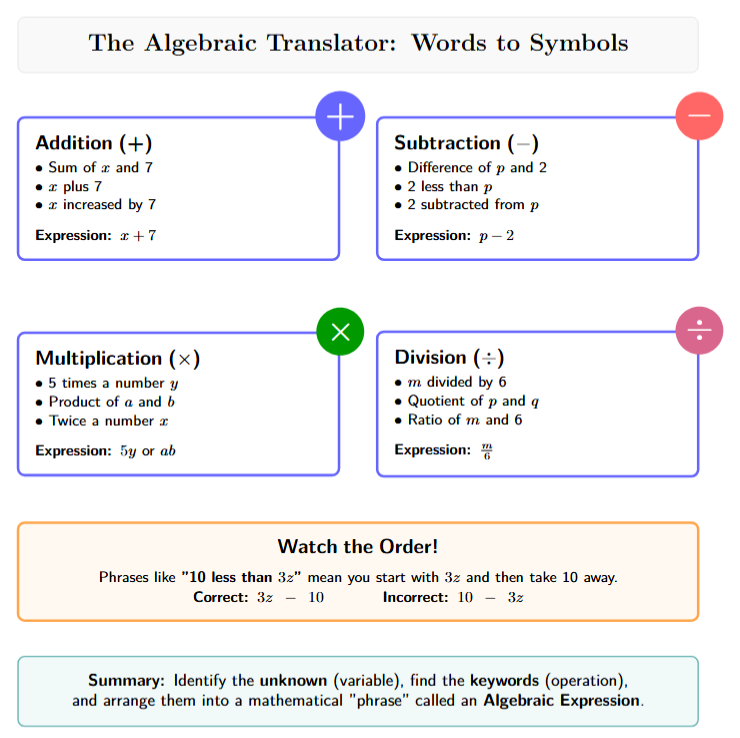
- Identify the operations being performed (e.g., "sum of" means addition, "less than" means subtraction, "times" means multiplication, "divided by" means division).
- Write the expression using the variable, constants, and operation symbols according to the order described in the statement.
Here are some examples of translating common verbal phrases into algebraic expressions:
- "Sum of $x$ and $7$": This means adding $x$ and $7$. Expression: $x + 7$ (or $7 + x$).
- "Difference of $p$ and $2$": This usually means $p$ minus $2$. Expression: $p - 2$.
- "$2$ less than $p$": This also means $p$ minus $2$. Expression: $p - 2$.
- "Difference of $2$ and $p$": This means $2$ minus $p$. Expression: $2 - p$.
- "$5$ times a number $y$": This means $5$ multiplied by $y$. Expression: $5y$.
- "The product of $a$ and $b$": This means $a$ multiplied by $b$. Expression: $ab$.
- "A number $m$ divided by $6$": This means $m$ divided by $6$. Expression: $\frac{m}{6}$.
- "$6$ divided by a number $m$": This means $6$ divided by $m$. Expression: $\frac{6}{m}$.
- "Twice a number $x$ increased by $3$": "Twice a number $x$" is $2x$. "increased by $3$" means add $3$. Expression: $2x + 3$.
- "$10$ less than three times a number $z$": "Three times a number $z$" is $3z$. "$10$ less than that" means subtract $10$ from $3z$. Expression: $3z - 10$. (Not $10 - 3z$)
- "The quotient of a number $p$ and $q$": This means $p$ divided by $q$. Expression: $\frac{p}{q}$.
Example 1. Write the algebraic expression for the following statements:
(a) Subtract 5 from a number y.
(b) 4 times a number p.
(c) 7 added to three times a number x.
Answer:
(a) "Subtract 5 from a number y" means we start with the number y and take away 5. This is represented by subtraction.
Expression: $y - 5$.
(b) "4 times a number p" means we multiply the number p by 4. This can be written as $4 \times p$, which is commonly written as $4p$ in algebra.
Expression: $4p$.
(c) "7 added to three times a number x". We break this down:
First, "three times a number x" means $3 \times x$, which is $3x$.
Then, "7 added to" that result means we add 7 to $3x$.
Expression: $3x + 7$.
Equation
In the previous sections, we learned about variables, constants, and how to combine them to form algebraic expressions. Now, we will look at a very important concept in algebra that uses these expressions to represent relationships and help us find unknown values – the Equation.
What is an Equation?
An Equation is a mathematical statement that shows that two expressions are equal in value. It is formed by placing an equals sign ($=$) between two expressions. These expressions can be algebraic expressions, constants, or a combination of both.
Think of an equation as a perfectly balanced scale. The expression or value on the left side of the equals sign must be exactly equal to the expression or value on the right side to maintain the balance (equality).

If you add or remove weight from one side of a physical balance, it becomes unbalanced. Similarly, if you change the value of one side of an equation, the equality is broken. To keep the equation true (balanced), any operation you perform on one side of the equals sign must also be performed on the other side.
Examples of Equations:
- $x + 5 = 12$: The expression $x+5$ is equal to the constant $12$.
- $2y - 3 = 7$: The expression $2y-3$ is equal to the constant $7$.
- $m = 10$: The variable $m$ is equal to the constant $10$.
- $3p + 1 = 2p + 5$: The expression $3p+1$ is equal to the expression $2p+5$.
- $7 = 7$: Two constants are equal (This is a trivial equation).
Left Hand Side (LHS) and Right Hand Side (RHS)
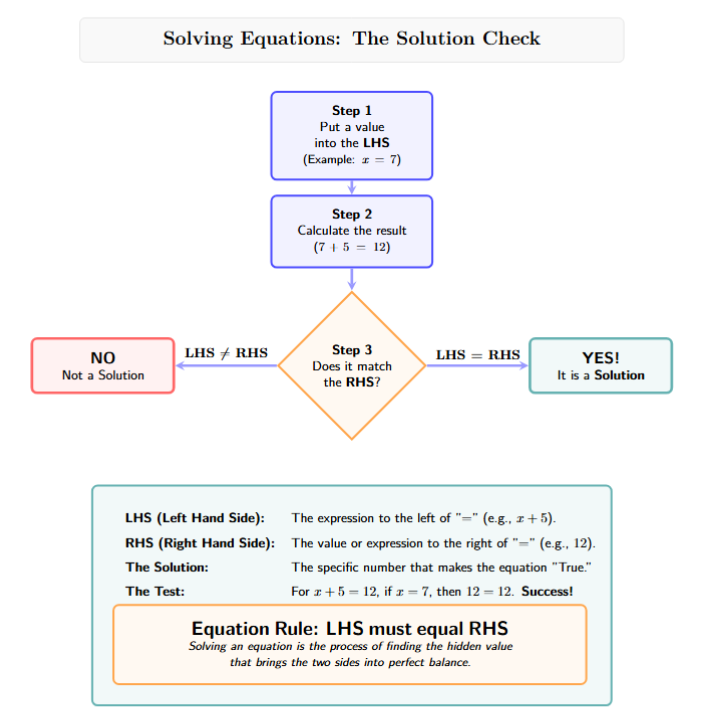
In any equation, the part of the statement that is to the left of the equals sign ($=$) is called the Left Hand Side (LHS) of the equation.
The part of the statement that is to the right of the equals sign ($=$) is called the Right Hand Side (RHS) of the equation.
For an equation to be true, the value of the expression on the LHS must be exactly equal to the value of the expression on the RHS.
Example: In the equation $3x + 1 = 16$:
- The Left Hand Side (LHS) is the expression $3x + 1$.
- The Right Hand Side (RHS) is the constant $16$.
For this equation to be true, the value of $3x+1$ must be equal to $16$.
Solution of an Equation
An equation involving a variable is a conditional statement – it is only true for certain values of the variable. The value (or values) of the variable that makes the equation true (i.e., makes LHS = RHS) is called the Solution of the equation.
Finding the solution to an equation is a major goal in algebra. This process is often called solving the equation.
Example: Consider the equation $x + 5 = 12$. We want to find the value of $x$ that makes this equation true.
Let's test some values for $x$:
- If we take $x = 1$:
LHS $= 1 + 5 = 6$.
RHS $= 12$.
Since $6 \neq 12$, $x=1$ is not the solution.
- If we take $x = 5$:
LHS $= 5 + 5 = 10$.
RHS $= 12$.
Since $10 \neq 12$, $x=5$ is not the solution.
- If we take $x = 7$:
LHS $= 7 + 5 = 12$.
RHS $= 12$.
Since $12 = 12$, LHS = RHS. This means the equation is true when $x=7$.
So, the solution to the equation $x + 5 = 12$ is $x = 7$.
Forming Equations from Statements
Just as we translated verbal statements into algebraic expressions, we can also translate statements that involve equality into equations. Look for keywords that imply equality, such as "is equal to", "is", "gives", "the result is", etc.
Steps to form an equation from a verbal statement:
- Identify the unknown quantity and represent it with a variable (e.g., $x, y, n$).
- Identify the constants involved.
- Translate the operations described in the statement into an algebraic expression involving the variable and constants.
- Look for the word(s) indicating equality and place the equals sign ($=$).
- Write the expression or value that the first expression is equal to on the other side of the equals sign.
Here are some examples:
- "The sum of a number $p$ and $10$ is $15$."
- Unknown number: $p$
- Operation: Sum ($+$)
- Constants: 10, 15
- Equality: "is"
- Equation: $p + 10 = 15$.
- "Subtracting $3$ from a number $y$ gives $8$."
- Unknown number: $y$
- Operation: Subtracting 3 from $y$ ($y - 3$)
- Constants: 3, 8
- Equality: "gives"
- Equation: $y - 3 = 8$.
- "Twice a number $m$ is $14$."
- Unknown number: $m$
- Operation: Twice a number ($2 \times m = 2m$)
- Constants: 2, 14
- Equality: "is"
- Equation: $2m = 14$.
- "A number $z$ divided by $4$ is $5$."
- Unknown number: $z$
- Operation: Divided by 4 ($\frac{z}{4}$)
- Constants: 4, 5
- Equality: "is"
- Equation: $\frac{z}{4} = 5$.
- "$5$ less than a number $x$ is equal to $2$."
- Unknown number: $x$
- Operation: 5 less than $x$ ($x - 5$)
- Constants: 5, 2
- Equality: "is equal to"
- Equation: $x - 5 = 2$.
From Equation to Statement
We can also do the reverse: take a given equation and write a verbal statement that describes it.
Example: Write a statement for the equation $a - 4 = 6$.
LHS is $a - 4$ (4 subtracted from $a$, or 4 less than $a$). RHS is $6$. The sign is $=$.
Possible Statement 1: "4 subtracted from a number $a$ is equal to 6."
Possible Statement 2: "A number $a$ minus 4 gives 6."
Example: Write a statement for the equation $3p = 21$.
LHS is $3p$ (3 times $p$, or the product of 3 and $p$). RHS is $21$. The sign is $=$.
Possible Statement 1: "Three times a number $p$ is 21."
Possible Statement 2: "The product of 3 and a number $p$ is equal to 21."
Example: Write a statement for the equation $\frac{y}{5} = 10$.
LHS is $\frac{y}{5}$ (a number $y$ divided by 5). RHS is $10$. The sign is $=$.
Possible Statement: "A number $y$ divided by 5 is equal to 10."
Example 1. Write an equation for the following statement: "The sum of a number n and 5 is equal to 12."
Answer:
Let the unknown number be represented by the variable '$n$'.
The statement "The sum of a number $n$ and $5$" translates to the expression $n + 5$.
The phrase "is equal to $12$" indicates the equality sign and the value on the RHS.
Combining these parts, we form the equation:
$n + 5 = 12$
This equation represents the given statement.
Example 2. Check if $y=3$ is a solution to the equation $2y + 1 = 7$.
Answer:
The given equation is $2y + 1 = 7$.
A value for a variable is a solution if, when substituted into the equation, it makes the LHS equal to the RHS.
We are asked to check if $y=3$ is a solution.
Substitute $y=3$ into the Left Hand Side (LHS) of the equation:
$\text{LHS} = 2y + 1$
Replace the variable $y$ with the value $3$:
$= 2 \times 3 + 1$
Perform the multiplication first, then the addition:
$= 6 + 1$
$= 7$
Now, look at the Right Hand Side (RHS) of the original equation:
$\text{RHS} = 7$
Compare the value of the LHS after substitution with the value of the RHS:
LHS $= 7$
RHS $= 7$
Since LHS = RHS when $y=3$, the equation $2y + 1 = 7$ is true for $y=3$.
Therefore, $y=3$ is a solution to the equation $2y + 1 = 7$.